

General Liability Insurance Signal Hill
That last phrase is the one worth holding on to, because it draws a line the rest of this page follows. Below: the three business liability insurance coverages commonly listed together and which of them is actually this policy, what professional liability really covers – which is not what most descriptions suggest – and why damage to your own building belongs somewhere else entirely.
Three Offerings, Three Separate Policies
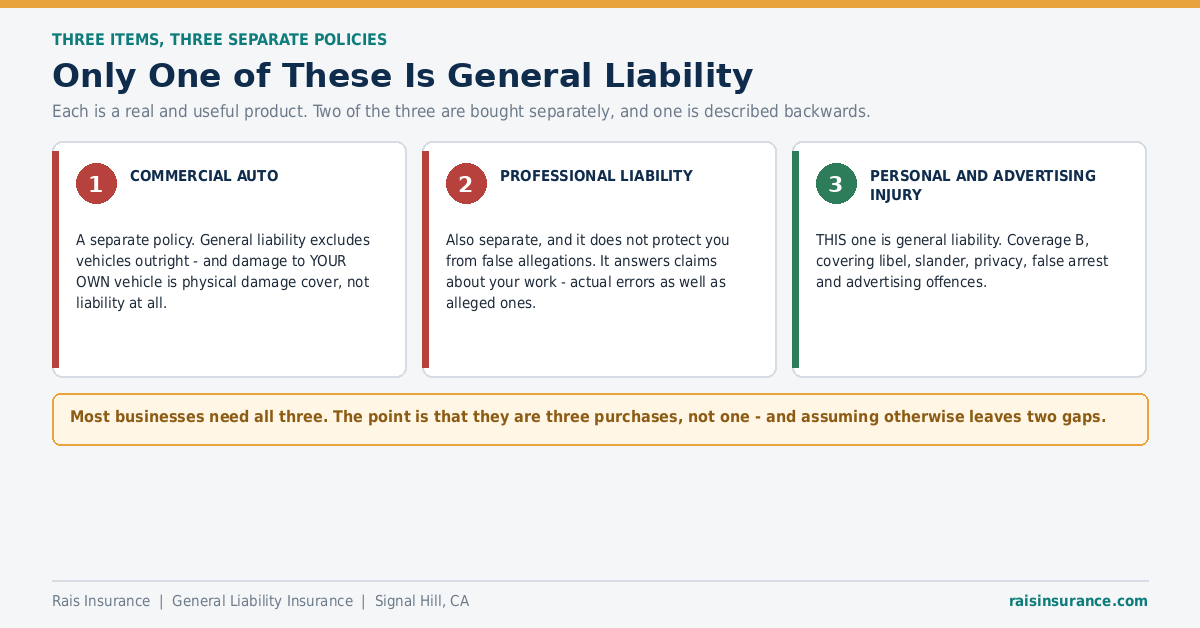
If you are not sure which policy you need, that is a reasonable place to start from – the products overlap in name more than they do in substance. Here are the three the original version of this page listed, with what each one genuinely is:
- Commercial auto. A separate policy, not part of general liability – which excludes vehicle liability outright. And a further distinction worth making: damage to your own vehicles is physical damage cover, meaning collision and comprehensive, which is not liability insurance at all. Liability pays for harm you cause to others; physical damage repairs your own property.
- Professional liability. Also separate, also genuinely important, and described backwards more often than any other policy. It is covered properly below.
- Personal and advertising injury. This one is general liability – Coverage B of the standard form. It answers libel and slander, invasion of privacy, wrongful eviction or entry, false arrest, malicious prosecution, use of another party’s advertising idea, and infringement of copyright, trade dress or slogan in your advertisement.
One small precision on that third item: these are civil claims brought against you, not criminal charges. A business is sued for defamation, not charged with it. The full set is on our the seven named offences in full page, and the wider picture of which policies a business needs is on which policies your business actually needs.
Professional Liability, Properly Explained
What professional liability actually covers
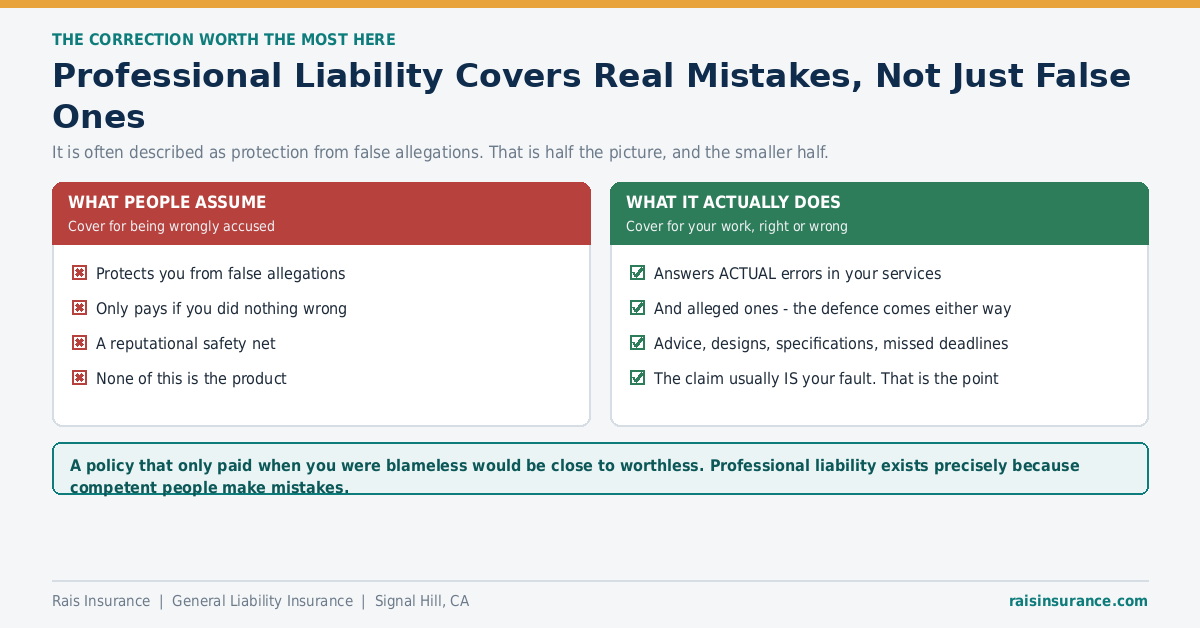
Professional liability – also called errors and omissions, or E&O – is regularly described as protection against false allegations. That is half the picture, and it is the smaller half.
The policy answers claims about your professional work whether the mistake was real or merely alleged. Advice that turned out wrong. A design that failed. A specification that did not work. A deadline missed with consequences for a client. In most E&O claims something genuinely did go wrong – and that is exactly the point.
A policy that only paid out when you were blameless would be close to worthless. Professional liability exists because competent people make errors, and because the cost of one can be far larger than the fee that was earned. The defence comes either way, which is what the “false allegations” framing is reaching for – but the cover is much broader than that.
And it renews differently
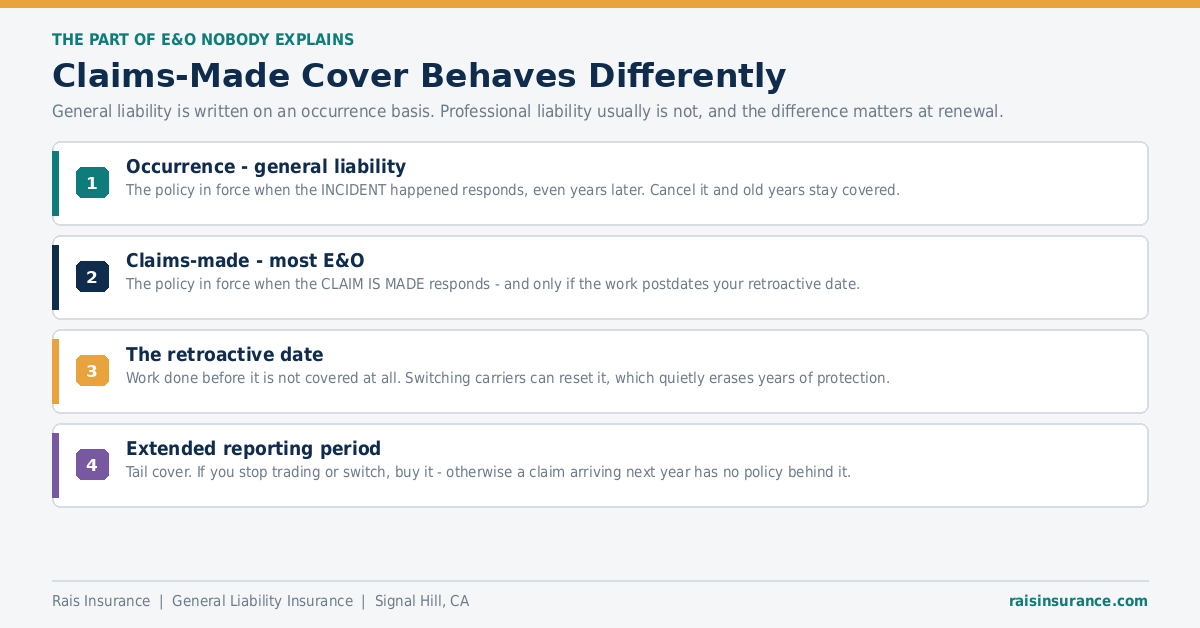
Here is the part almost nobody explains, and it is where businesses lose cover without realising. General liability is written on an occurrence basis. Professional liability usually is not.
- Occurrence, as in general liability. The policy in force when the incident happened is the one that responds, even if the claim arrives years later. Cancel the policy and past years stay protected. See occurrence cover and which policy answers a claim years later.
- Claims-made, as in most E&O. The policy in force when the claim is made responds – and only if the work postdates your retroactive date. Let the policy lapse and there is nothing behind the work you already did.
- The retroactive date. Work performed before it is not covered, however long you have held cover since. Switching carriers can reset it, which quietly erases years of protection. It is the single line to check before moving an E&O policy.
- The extended reporting period. Tail cover. If you retire, sell, stop trading, or move to a carrier who will not match your retroactive date, this keeps the claim window open. Without it, a claim arriving next year about work done last year has no policy behind it.
Natural Disasters Belong to a Different Policy Again
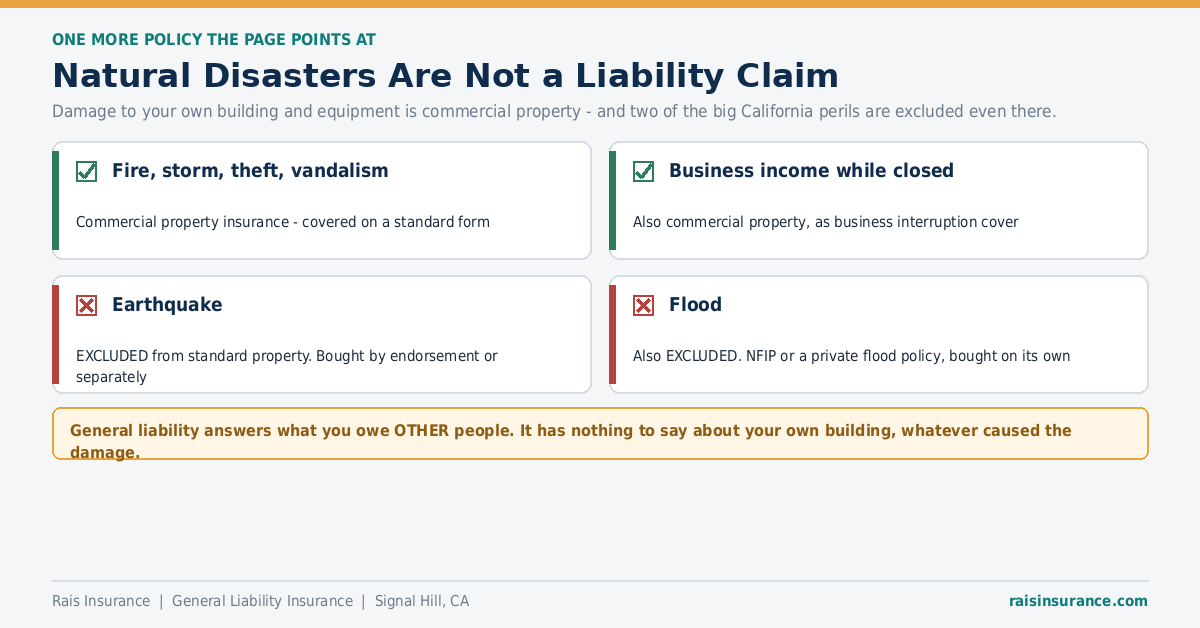
The original opens by raising natural disasters that could lay waste to your building and equipment. That is a real exposure and worth insuring – it is simply not this policy.
Damage to your own building, stock and equipment is commercial property insurance. General liability answers what you owe other people; property answers what you lose yourself. Fire, storm, theft and vandalism are covered on a standard property form, and business interruption cover replaces trading income while you cannot operate. See commercial property insurance.
Two California caveats worth knowing even once you have property cover. Earthquake is excluded from a standard property policy and has to be added by endorsement or bought separately. Flood is excluded too – see flood insurance in California. Both are the perils people most often assume are included, and neither is.
Four Things That Are Specific to Signal Hill
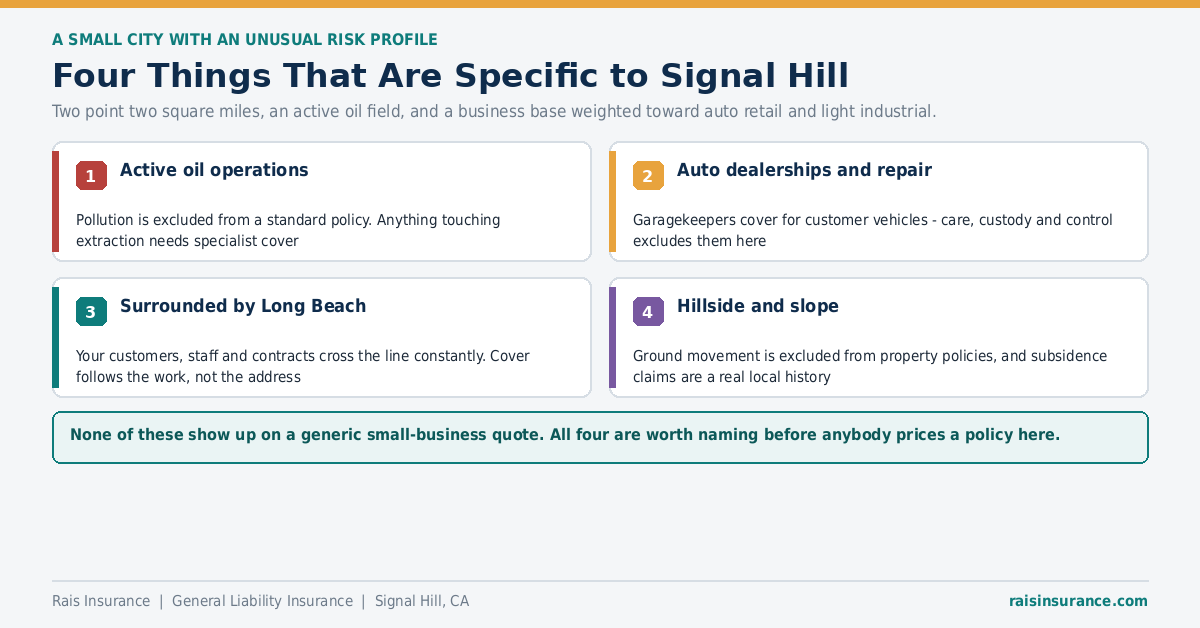
Signal Hill is barely two square miles, entirely surrounded by Long Beach, and carries a risk profile out of proportion to its size. Four things worth naming before anybody prices a policy here:
- Active oil operations. The pollution exclusion in a standard general liability policy is broad. Anything touching extraction, storage or remediation needs specialist environmental cover, and it will not be found inside a package policy.
- Auto dealerships and repair. Customer vehicles left in your care are excluded under care, custody and control. They need garagekeepers cover – and that applies whether the vehicle is being repaired, stored, valeted or test driven.
- The Long Beach boundary. Most Signal Hill businesses have customers, staff and contracts on both sides of a line you cross without noticing. Liability cover follows your operations rather than your address, so the work is covered – but contract limits set by Long Beach clients or landlords are worth checking against what you actually hold.
- Hillside and slope. Ground movement is excluded from property policies, and this is a city with genuine local history on that point. Worth a specific question rather than an assumption.
None of those appear on a generic small-business quote. For the wider exclusions picture, see what general liability does not cover.
What It Costs
There is no flat rate. Premium is built from your classification code, your gross receipts or payroll, the limits you select, your claims history and how much work you subcontract out. Signal Hill’s mix of auto retail, light industrial and oil-adjacent operations means the spread between two businesses a street apart can be wide. More in what actually sets your premium.
Working with Rais Insurance
If you are still deciding which policies you need, that is the conversation worth having rather than a rushed quote. Our consultants have long experience in the field and can walk you through the terms and the process – and, as the sections above suggest, the most useful part of that is usually explaining where one policy stops and the next begins.
One clarification on scope: we advise on coverage, which is what a licensed broker is qualified to do. Questions about whether you are legally liable, or what a contract clause commits you to, belong with an attorney.
We place the business insurance Signal Hill operators actually need, serving Signal Hill and the surrounding Long Beach area from our Anaheim office and writing across California.
General Liability Insurance Signal Hill – Frequently Asked Questions
Q1. Does professional liability only protect me from false allegations?
No – and a policy that only paid when you were blameless would be close to worthless. Professional liability, or errors and omissions, answers claims about your professional work whether the mistake was real or merely alleged. It exists precisely because competent people make errors: advice that turned out wrong, a design that failed, a specification that did not work, a deadline missed. The defence comes either way.
Q2. What is the difference between claims-made and occurrence cover?
An occurrence policy responds based on when the incident happened – general liability works this way, so a claim arriving five years later goes to the policy that was in force at the time. A claims-made policy responds based on when the CLAIM IS MADE, and only if the work postdates your retroactive date. Most professional liability is written claims-made, and the difference matters most at renewal.
Q3. What is a retroactive date?
The date on a claims-made policy before which your work is not covered at all. Work performed after it and claimed during the policy period is covered; work performed before it is not, however long you have held cover since. Switching carriers can reset that date, which quietly erases years of protection – so it is the single line to check before moving an E&O policy.
Q4. What is an extended reporting period?
Often called tail cover. Because a claims-made policy only responds while it is in force, stopping the policy leaves you exposed to claims about past work arriving afterwards. An extended reporting period keeps the claim window open for an agreed time. If you retire, sell, stop trading or switch to a carrier who will not match your retroactive date, this is what protects the work you already did.
Q5. Does general liability cover damage to my own business vehicle?
No, on two counts. General liability excludes vehicle liability outright – that is commercial auto. And repairs or replacement of your own vehicle are physical damage cover, meaning collision and comprehensive, which is not liability insurance at all. A personal auto policy can also decline a claim on business-use grounds, so a vehicle genuinely used for work needs its own commercial policy.
Q6. Does general liability cover natural disasters?
No. Damage to your own building, stock and equipment is commercial property insurance. General liability answers what you owe other people, not what you lose yourself. Worth knowing too that earthquake and flood are excluded even from a standard property policy in California – both are bought by endorsement or as separate policies.
Q7. What does personal and advertising injury actually cover?
This is the part of the original list that genuinely is general liability. It covers libel and slander, invasion of privacy, wrongful eviction or entry, false arrest and malicious prosecution, use of another party’s advertising idea, and infringement of copyright, trade dress or slogan in your advertisement. Note that these are civil claims brought against you, not criminal charges.
Q8. I run an auto business in Signal Hill. Is customer property covered?
Not under general liability. Vehicles left in your care are excluded by the care, custody and control provision, and they need garagekeepers cover instead. That applies whether the vehicle is being repaired, stored, valeted or test driven, and it is one of the most commonly missed exposures in an auto-heavy local market.
Q9. My business is in Signal Hill but most of my customers are in Long Beach. Does that matter?
Very little for the cover itself – a liability policy follows your operations rather than your address, so work performed across the city line is covered the same way. What it can affect is the areas your policy lists and any contract requirements from Long Beach clients or landlords, which are worth checking against your limits rather than assumed.
Q10. How much does general liability insurance cost in Signal Hill?
There is no flat rate. Premium is built from your classification code, gross receipts or payroll, the limits you buy, your claims history and how much work you subcontract. Signal Hill’s mix of auto retail, light industrial and oil-adjacent operations means the spread between neighbouring businesses here is wider than the city’s size would suggest.
Get a General Liability Insurance Quote in Signal Hill
If you are ready to protect your commercial assets properly, contact Rais Insurance and we will work out which policies apply before quoting a price. Call 714-761-4336, email rai@raisinsurance.com, or visit 2612 W. Lincoln Avenue, Suite 103, Anaheim, CA 92801.
If you already hold professional liability, bring that declarations page too. The retroactive date on it is worth five minutes of anybody’s attention.
