

General Liability Insurance Costa Mesa

Every Costa Mesa business needs general liability insurance with Rais Insurance for the same reason: the claims that damage a company are rarely the ones anyone saw coming, and a surprising number of them turn out to be groundless. This page covers what the policy does, what it pays for, and the one feature most owners never read — the obligation your insurer takes on to defend you even when the claim against you is false.
What Is General Liability Insurance?
Also known as commercial general business liability, it is one of the many insurance solutions we offer at Rais Insurance. The policy provides your company and your assets with protection in the event that you cause damage or injury to a third party. A third party here is any individual who is not part of your company — a client, a customer, a supplier, or a business partner.
It also covers medical, treatment, and rehabilitation costs if somebody outside your company is hurt because of your company’s negligence. And should someone sue you or file legal action against you, the policy covers your legal fees along with the non-monetary losses claimed by the injured party.
Four Claims and What General Liability Pays
The definition is abstract. What it looks like in practice is this:
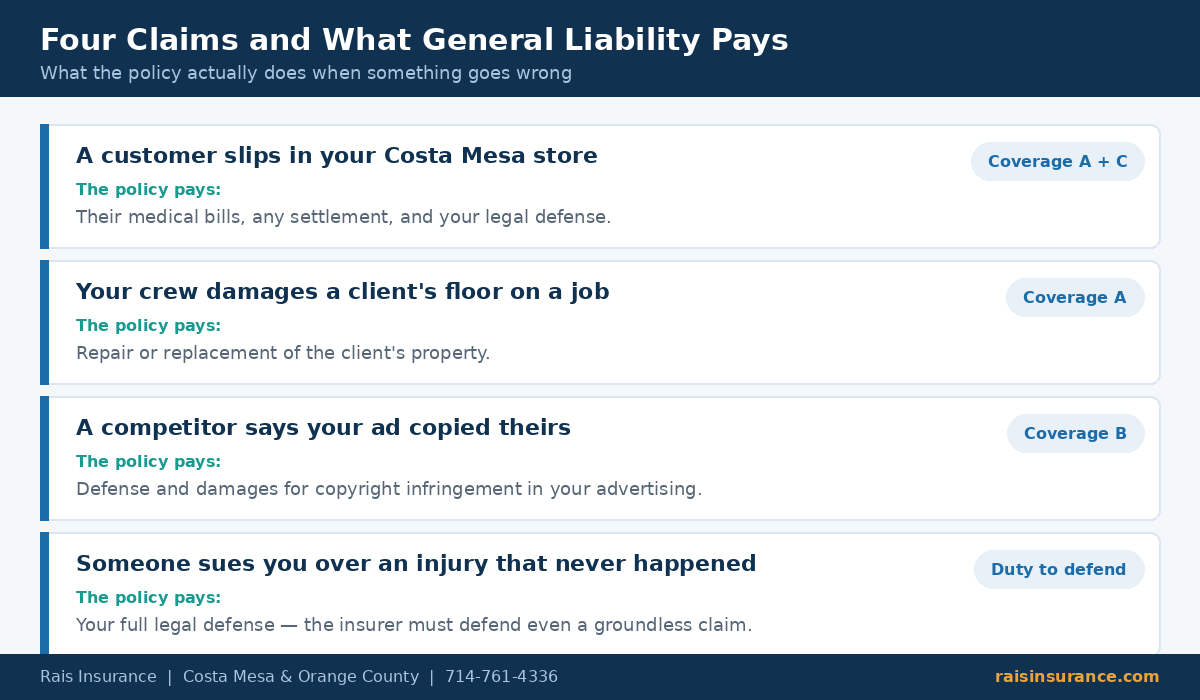
- A customer slips in your Costa Mesa store. The policy pays their medical bills, any settlement, and your legal defense.
- Your crew damages a client’s floor on a job. The policy pays to repair or replace the client’s property.
- A competitor claims your advertising copied theirs. The policy’s personal and advertising injury coverage responds to copyright infringement arising from your advertising.
- Someone sues you over an injury that never happened. The policy pays your full legal defense anyway — see the next section, because this one is the point.
The Duty to Defend: Why a False Claim Still Costs You
It is not enough to assume you will never find yourself the victim of a false claim. It is always better to stay on the safe side — otherwise you can lose thousands of dollars simply because a case was made against your company, whether or not there was anything behind it.
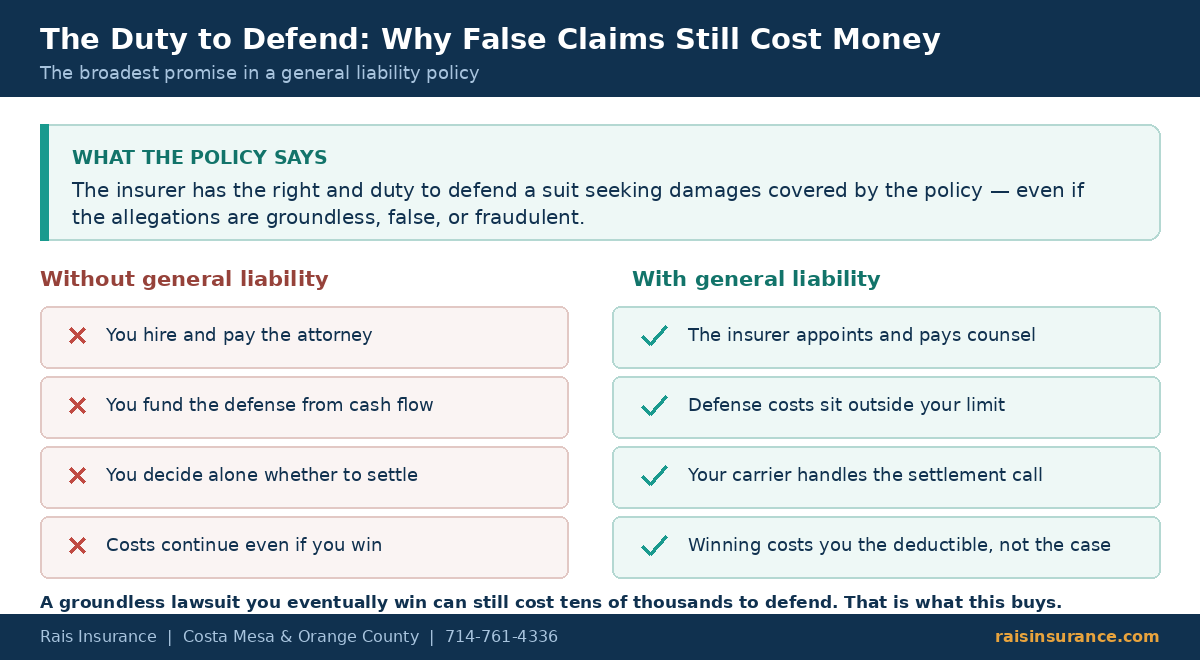
Here is the part that matters, and it is written into the policy itself. A standard commercial general liability form gives your insurer the right and duty to defend a suit seeking covered damages even if the allegations are groundless, false, or fraudulent. That is not a marketing claim; it is the wording of the form.
The practical difference is large. Without the policy, you hire the attorney, you fund the defense out of cash flow, and you carry the cost even when you win. With it, the insurer appoints and pays counsel, and on a standard form those defense costs sit outside your policy limit rather than eating into the money available to settle.
That is why choosing general liability insurance in Costa Mesa is a smart move for your business. It spares you the trouble and expense of dealing with false claims, and with a policy from Rais Insurance you can cover all your bases.
Occurrence vs. Claims-Made: Check Your Declarations Page
Two policies with identical limits can behave completely differently, and the difference is printed on your declarations page.
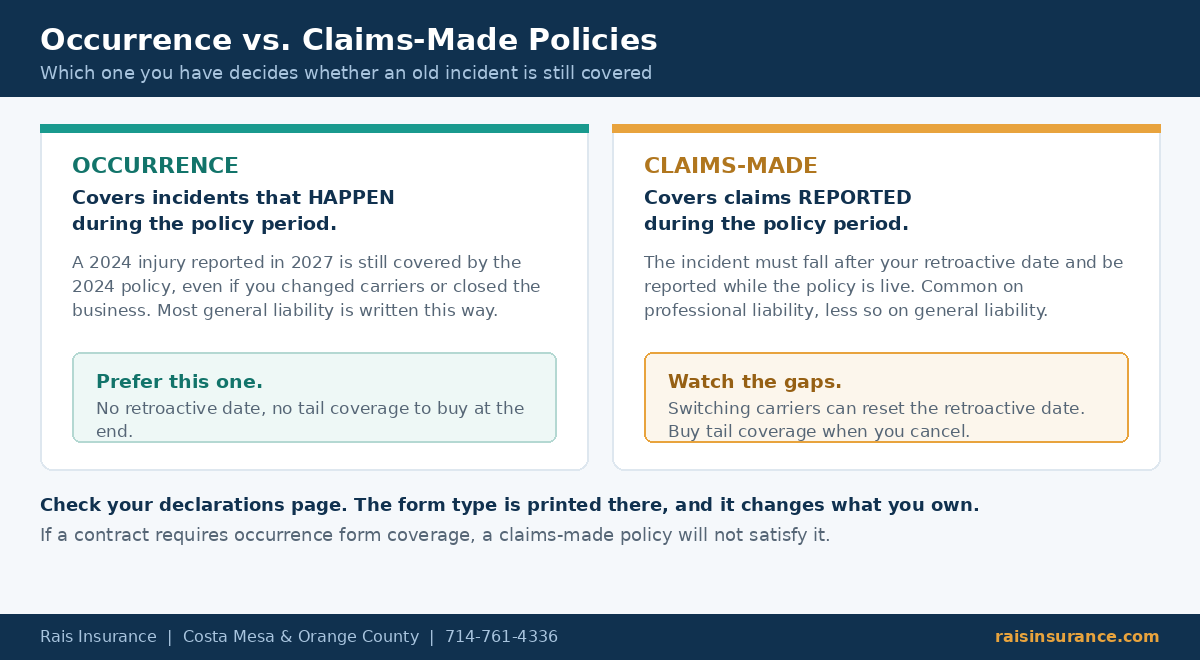
An occurrence policy covers incidents that happen during the policy period, whenever the claim eventually arrives. An injury in 2024 reported in 2027 is still covered by the 2024 policy — even if you changed carriers or closed the business. Most general liability is written this way, and it is the stronger form for a business owner.
A claims-made policy only covers claims reported while the policy is active, and only for incidents after its retroactive date. Switching carriers can reset that date, and cancelling without buying tail coverage can leave a gap for work you have already completed. It is common on professional liability and less so on general liability — but if a contract specifies occurrence form coverage, a claims-made policy will not satisfy it.
What Your Policy Excludes
Three exclusions catch Costa Mesa businesses more often than any others:
- Liquor liability. A standard general liability policy excludes claims arising from alcohol for businesses that manufacture, distribute, sell, serve, or furnish it. If you run a restaurant, bar, or brewery, you need a separate liquor liability policy — your general liability will not respond. Businesses outside the alcohol trade usually do have host liquor coverage for the occasional company event.
- Professional services. Advice, design, or professional judgment that costs a client money is not general liability. That is professional liability, also called errors and omissions.
- Care, custody, and control. Damage to property that is in your possession or that you are working on may fall outside the standard property damage coverage. Contractors and anyone storing client property should ask about this specifically.
Injuries to your own employees, damage to your own premises, and vehicle accidents are handled by other policies entirely. We will map those out with you rather than leaving you to discover them at claim time.
Costa Mesa Business Types and Their Real Exposure
Costa Mesa’s commercial base is unusually varied for its size — retail and showrooms, one of the densest restaurant and brewery clusters in Orange County, design and apparel firms, contractors, professional practices, and a steady flow of event and festival vendors. Each faces a different claim:
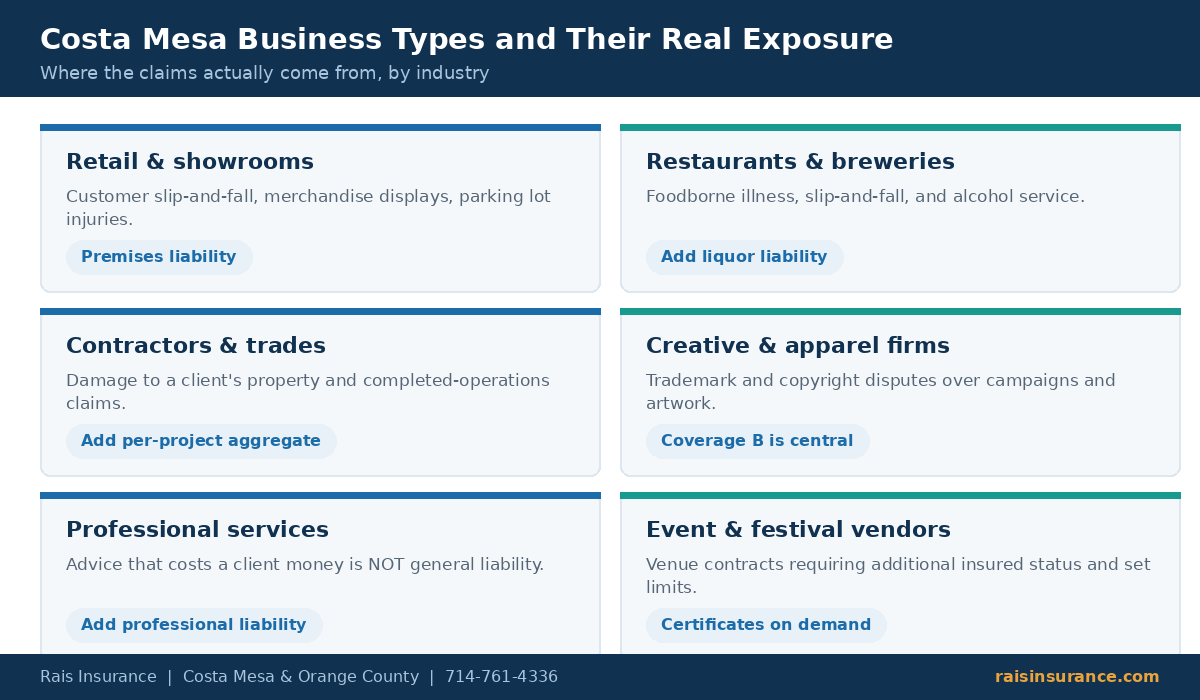
- Retail and showrooms — customer slip-and-fall, display injuries, and parking lot incidents. Premises liability is the whole exposure.
- Restaurants and breweries — slip-and-fall, foodborne illness, and alcohol service. Add liquor liability.
- Contractors and trades — damage to a client’s property and completed-operations claims after the job ends. Ask about a per-project aggregate.
- Creative and apparel firms — trademark and copyright disputes over campaigns and artwork. Personal and advertising injury coverage is central rather than incidental.
- Professional services — general liability covers the client who trips in your lobby, not the advice that cost them money. Add professional liability.
- Event and festival vendors — venue contracts requiring additional insured status at stated limits, usually before load-in.
Consult Us: What to Consider Before You Choose a Policy
Look for the coverage you need. Not sure what to look out for? Here are the things worth thinking about before you decide:
- Determine the risks associated with the kind of business you have, as well as the products or services you provide.
- Where you operate matters. Some states award considerably more in personal injury damages than others, and if you work across state lines your exposure changes with you.
- Read your lease and your client contracts first. They usually dictate your limits, your additional insured wording, and sometimes your policy form. Buying before you read them means buying twice.
- Check whether you need coverage your general liability excludes — liquor, professional liability, cyber, or commercial auto.
- Ask whether defense costs sit inside or outside your limit. On a standard general liability form they sit outside, but not every policy you will be offered is standard.
There are plenty of other things to weigh before settling on the best features and coverage for your general liability insurance in Costa Mesa. At Rais Insurance we will be there for you at every step.
How Much Coverage Do You Need?
One million dollars per occurrence with a two million aggregate is the usual starting point, and it satisfies most Costa Mesa commercial leases. Beyond that, the number is almost never set by your own risk assessment — it is set by whoever you are contracting with.
Venues, general contractors, corporate clients, and municipal permits routinely demand higher limits. When they do, an umbrella policy sitting above your general liability is usually far cheaper than raising the underlying limit to match. Bring us the contract and we will price the combination rather than guessing at a number.
Serving Costa Mesa and Orange County
We write business insurance for Costa Mesa companies from our office in Anaheim, roughly twelve miles away, and across Orange County — Newport Beach, Irvine, Santa Ana, Huntington Beach, and Fountain Valley. For commercial risks that closeness is useful: we can walk the premises before we quote it rather than rating it off a form.
We also write commercial property insurance, workers’ compensation, and commercial auto insurance, so the exposures general liability excludes do not become someone else’s problem to solve. See our full general liability insurance coverage, or our page for businesses in Escondido.
Get a General Liability Insurance Quote in Costa Mesa
To quote it properly we need three things: what your business actually does day to day, your annual revenue or payroll, and any limits your lease or client contracts require. If you have had a claim in the last three years, send the loss run too.
Call us for help today. 714-761-4336, or email rai@raisinsurance.com.
Costa Mesa General Liability Insurance FAQs
Q1. Does general liability insurance cover false or groundless claims?
Yes. A standard commercial general liability policy states that the insurer has the right and duty to defend a suit seeking covered damages even if the allegations are groundless, false, or fraudulent. You still get a paid legal defense for a claim that turns out to be baseless, which is often the most valuable thing the policy does.
Q2. What is the duty to defend?
The duty to defend is the insurer’s obligation to appoint and pay for your legal defense when a claim is made. It is broader than the duty to pay damages: it is triggered by what the lawsuit alleges, not by whether those allegations turn out to be true. On a standard CGL form these defense costs are paid in addition to your policy limit.
Q3. What is the difference between an occurrence and a claims-made policy?
An occurrence policy covers incidents that happen during the policy period, whenever the claim is reported. A claims-made policy only covers claims reported while the policy is active and after its retroactive date. Most general liability is written on an occurrence form, which is the stronger of the two for a business owner.
Q4. Does general liability cover alcohol served at my restaurant or brewery?
No. A standard general liability policy excludes liability arising from alcohol for businesses that manufacture, distribute, sell, serve, or furnish it. Restaurants, bars, and breweries need a separate liquor liability policy. Businesses that are not in the alcohol trade usually do have host liquor coverage for occasional events.
Q5. How much general liability coverage does a small business need?
One million dollars per occurrence and two million aggregate is the common starting point and satisfies most commercial leases. Higher limits are driven by contracts rather than by risk appetite: venues, general contractors, and corporate clients frequently require more, and an umbrella policy is usually the cheapest way to reach their number.
Q6. Does my commercial lease require general liability insurance?
Almost certainly. Nearly every commercial lease in Orange County requires the tenant to carry general liability at a stated limit and to name the landlord as an additional insured. Read the insurance clause before you sign, because the limits and endorsements it demands determine what you need to buy.
Q7. Does general liability cover damage I cause to a client’s property?
Yes, in most cases. Damage to property belonging to a third party arising out of your operations falls under the policy’s property damage coverage. There are exceptions worth knowing, particularly for property in your care, custody, or control, which may need a separate endorsement.
Q8. What is completed operations coverage and do I need it?
Completed operations covers claims that arise after a job is finished, rather than while you are still on site. If you build, install, repair, or manufacture anything, you need it, because that is when most claims against contractors actually surface. It is included in a standard CGL but can be restricted by endorsement, so check.
Q9. Will my premium go up if a claim against me is dismissed?
It can. Even a claim that is dismissed appears on your loss runs and usually cost the insurer money to defend, and underwriters look at claim frequency as well as amounts paid. This is not a reason to avoid reporting a claim — late reporting causes far more problems than the claim itself.
Q10. Am I covered when I work at a client’s site or an event venue?
Generally yes, since general liability follows your operations rather than one address. The practical issue is documentation: the venue or client will require a certificate of insurance naming them as an additional insured, often with specific limits and wording, before they let you on site.
