

Auto Insurance Laguna Hills California
Which raises the question every car insurance policy here turns on, and which the original version of this page opens and never quite answers: how is fault actually decided? It matters, because in an at-fault state that decision determines who pays for what.
How Fault Is Actually Decided
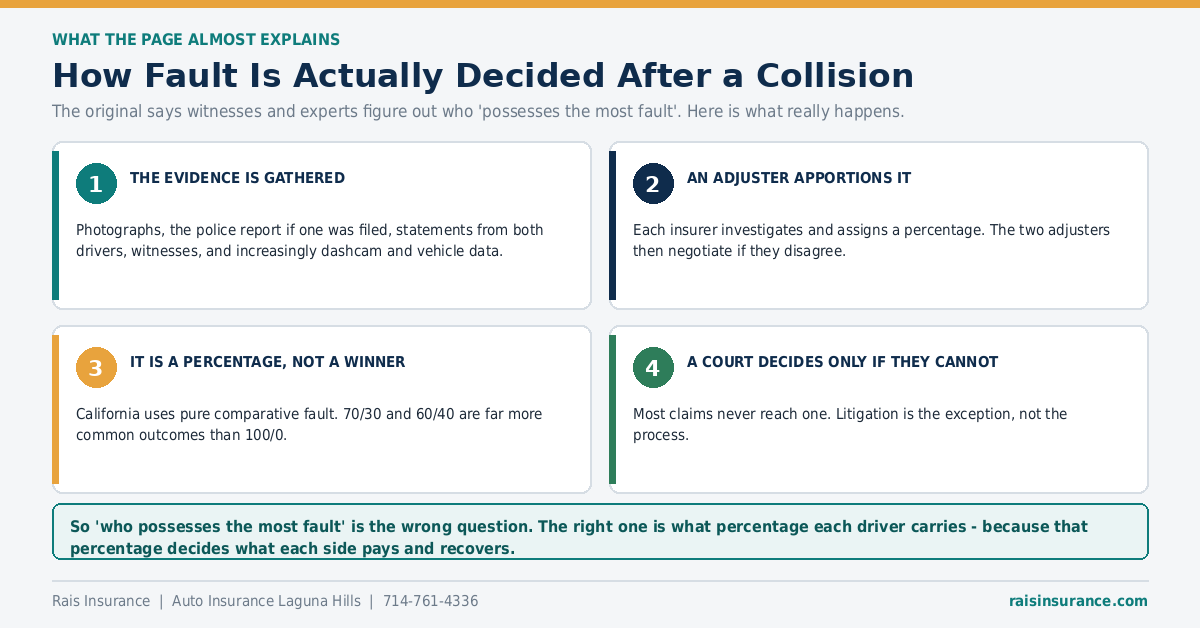
The original says insurance companies use witnesses and experts to work out who “possesses the most fault”. The instinct is right – evidence decides it – but the framing is not, because California does not award fault to one driver:
- The evidence is gathered. Photographs of both vehicles and the scene, the police report where one was filed, statements from both drivers, witness accounts, and increasingly dashcam footage and vehicle data.
- An adjuster apportions it. Each insurer investigates and assigns a percentage of responsibility. Where the two disagree, their adjusters negotiate.
- It is a percentage, not a winner. California uses pure comparative fault – 70/30 and 60/40 are far more common outcomes than 100/0, and there is no cut-off, so even a driver mostly at fault recovers something. See how liability limits actually work.
- A court decides only if they cannot. The overwhelming majority of claims never reach one. Litigation is the exception rather than the process.
One further point on evidence: a police report does not decide fault. It carries weight and insurers read it carefully, but the officer was not present at the moment of impact. A report that seems to favour the other driver is not the end of the matter.
What you do at the scene affects the split
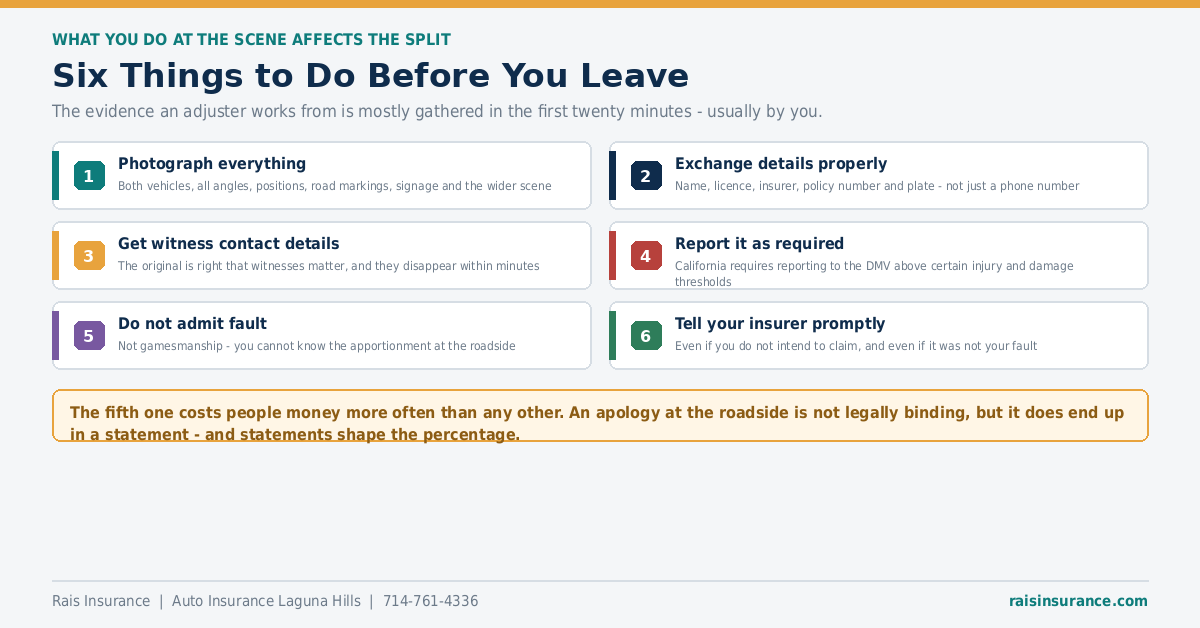
Since the evidence a car insurance adjuster works from is mostly gathered in the first twenty minutes – usually by the drivers themselves – six things are worth doing before you leave:
- Photograph everything. Both vehicles from all angles, their positions, road markings, signage and the wider scene.
- Exchange details properly – name, licence, insurer, policy number and plate, not just a phone number.
- Get witness contact details. The original is right that witnesses matter, and they disperse within minutes.
- Report it where required. California has a DMV reporting requirement above certain injury and property damage thresholds, separate from any police involvement.
- Do not admit fault. Not as gamesmanship – you genuinely cannot know the apportionment at the roadside. An apology is not legally binding, but it does end up in a statement, and statements shape the percentage.
- Tell your insurer promptly, even if you do not intend to claim and even if the accident was not your fault.
Whose Insurer Actually Pays
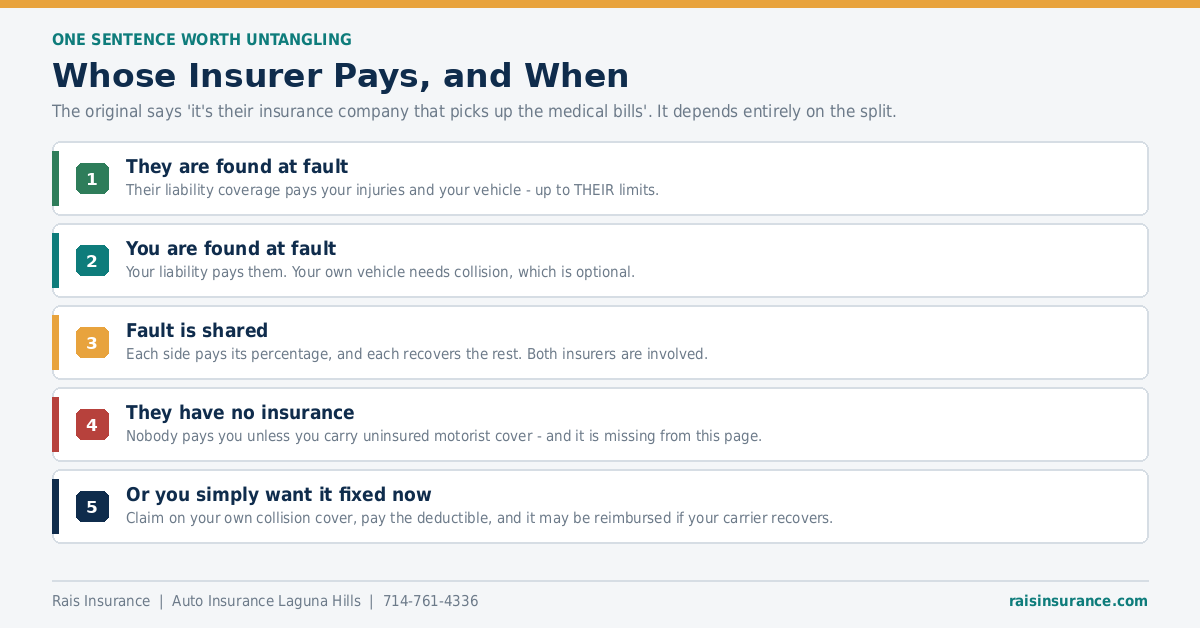
The original says “it’s their insurance company that picks up the medical bills and collision damage, as per the limits of the liability coverage”. That is right in one scenario and misleading across the others, so it is worth setting out properly:
- They are found at fault – their liability coverage pays your injuries and your vehicle, up to their limits.
- You are found at fault – your liability pays them. Your own vehicle needs collision cover, which is optional.
- Fault is shared – each side pays its percentage and recovers the rest. Both insurers are involved.
- They have no insurance – nothing responds unless you carry uninsured motorist cover. That is optional in California, a carrier must obtain your decline in writing, and it is missing from the original version of this page.
- Or you simply want the car fixed now – you can claim on your own collision cover, pay the deductible, and it may be reimbursed later if your carrier recovers from theirs.
The original is also right that liability is about negligence – it responds when the loss results from your carelessness. That is a more precise framing than most pages manage, and it is why fault has to be established before anything is paid.
Collision, and When It Stops Being Worth It
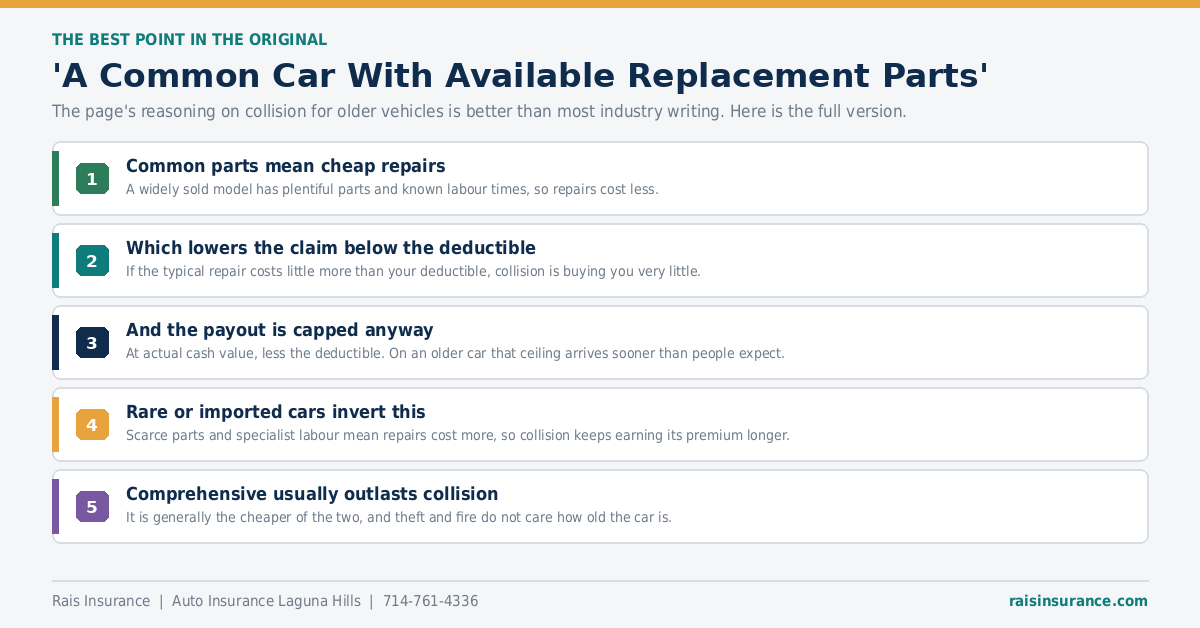
The original’s reasoning here is better than most industry writing, and it is kept: liability protects the other party but not you or your vehicle, and collision is the layer that covers your own damage. On older cars it may not be worth carrying – “especially if you drive a common car with available replacement parts”. That parenthetical is the sharpest thing on the page. Expanded:
- Common parts mean cheaper repairs. A widely sold model has plentiful parts and known labour times.
- Which pushes the typical claim toward your deductible. If a normal repair costs little more than the deductible, collision is buying you very little.
- And the payout is capped anyway, at actual cash value less the deductible. On an older vehicle that ceiling arrives sooner than most people expect.
- Rare or imported cars invert it. Scarce parts and specialist labour push repair costs up, so collision keeps earning its premium for longer.
- Comprehensive usually outlasts collision, because it is generally the cheaper of the two and theft and fire do not care how old the car is.
The full calculation is on our when collision and comprehensive stop earning their premium page.
Comprehensive, and What Else Belongs on the Policy
The original describes comprehensive correctly – cars are not only at risk from the road, and theft, vandalism and natural disasters all sit outside a collision claim. See what comprehensive coverage actually covers.
Two auto insurance coverages belong alongside it and are absent from the original:
- Property damage liability is not merely optional – along with bodily injury liability it is one of the two coverages California requires. The page refers to liability generally without naming its two halves.
- Uninsured and underinsured motorist cover, which is the only thing that responds when the at-fault driver has no insurance or not enough of it. In a fault-based state that is the most consequential gap on any policy.
Driving in Laguna Hills
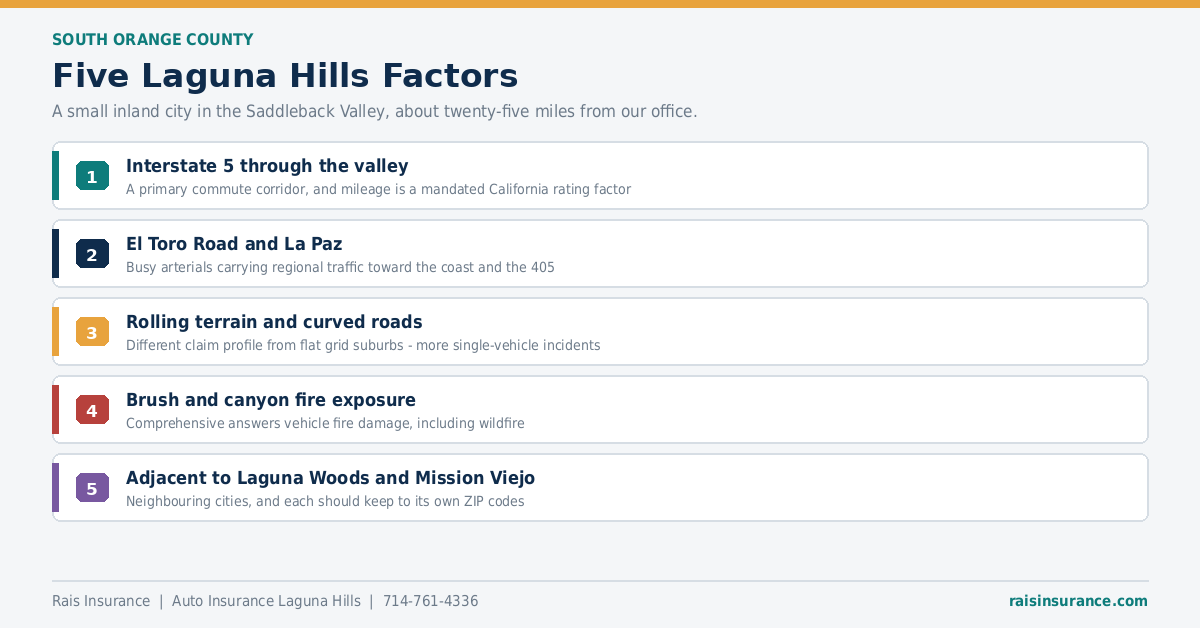
Five things that shape car insurance Laguna Hills rates specifically, on top of the auto insurance Laguna Hills basics above:
- Interstate 5 through the Saddleback Valley, a primary commute corridor – and annual mileage is one of the three factors California law requires to weigh most heavily.
- El Toro Road and La Paz, busy arterials carrying regional traffic toward the coast and the 405.
- Rolling terrain and curved roads, which produce more single-vehicle incidents than flat grid suburbs – and those are collision claims, on your own policy.
- Brush and canyon fire exposure, which comprehensive answers.
- Neighbouring Laguna Woods and Mission Viejo, each of which is a separate city with its own ZIP codes.
Building the Policy Around You
The original’s framing is a good one: because cover can be expensive, you build a policy that reflects your budget, your car and how you drive. The four auto insurance decisions are your liability limits, which optional coverages you carry, what deductible you set, and which carrier writes it.
As an independent broker we place business across a panel of carriers rather than selling one company’s products, so one set of details gets quoted several times – see the insurance companies we represent. We are not an insurance company; the carrier issues the policy and pays the claim, and there is no fee to you for the comparison. The current minimum limits are on our auto insurance in California page.
Auto Insurance in Laguna Hills – Frequently Asked Questions
Q1. Who decides who is at fault in a car accident?
An insurance adjuster, in almost every case. Each insurer investigates and assigns a percentage of responsibility, and if the two disagree their adjusters negotiate. A court decides only in the small minority of claims that reach litigation – so the process most drivers actually experience is an adjuster reviewing evidence, not a judge.
Q2. What evidence is used to determine fault?
Photographs of both vehicles and the scene, the police report where one was filed, statements from both drivers, witness accounts, and increasingly dashcam footage and data from the vehicles themselves. Most of it is gathered in the first twenty minutes after a collision, usually by the drivers involved.
Q3. Does a police report decide who was at fault?
No. A police report is evidence and it carries weight, but it is not a determination – the officer was not present at the moment of impact. Insurers weigh it alongside the photographs, the statements and the physical damage. A report that appears to favour the other driver is not the end of the matter.
Q4. Can both drivers be at fault?
Yes, and in California both can still recover. The state uses pure comparative fault, which apportions responsibility as a percentage rather than treating accidents as all-or-nothing. If you are found 30 per cent responsible, you are liable for 30 per cent of their damages and can recover 70 per cent of yours – and there is no cut-off, so even a driver mostly at fault recovers something.
Q5. Should I admit fault at the scene?
No, and not for tactical reasons – you genuinely cannot know the apportionment in the first minute. It depends on evidence, statements and sometimes reconstruction. Report the facts accurately to the police and to your insurer, exchange details, photograph everything, and let fault be assessed on the evidence.
Q6. Do I have to report an accident in California?
Above certain injury and property damage thresholds, yes – there is a DMV reporting requirement separate from any police involvement. It is also worth telling your own insurer promptly even where you do not intend to claim and even where the accident was not your fault, because late notice can complicate a claim later.
Q7. Whose insurance company pays?
It depends on the split. If they are at fault, their liability coverage pays you up to their limits. If you are, yours pays them and your own vehicle needs collision cover. Where fault is shared, each side pays its percentage. And if they have no insurance, nothing responds unless you carry uninsured motorist cover.
Q8. Should I claim on my own insurance if it was not my fault?
Sometimes. Claiming on your own collision cover is usually faster than waiting for the other insurer to accept liability, and your deductible may be reimbursed if your carrier recovers from theirs. The trade-off is that it appears as a claim on your record, so it is worth discussing before deciding.
Q9. Do I need collision coverage on an older car?
The original version of this page reasons about this unusually well. A common vehicle with widely available parts costs less to repair, so the typical claim may not greatly exceed your deductible – and the payout is capped at actual cash value in any case. A rare or imported car inverts that, because scarce parts and specialist labour push repair costs up.
Q10. How do I get a Laguna Hills auto insurance quote?
Call Rais Insurance on 714-761-4336 or email rai@raisinsurance.com. Our office is in Anaheim, about twenty-five miles north, so Laguna Hills is served by phone and email. We are an independent broker, so one set of details is quoted across several carriers, and there is no fee to you for the comparison.
Get a Car Insurance Quote in Laguna Hills
contact Rais Insurance on 714-761-4336 or email rai@raisinsurance.com.
Have your car insurance declarations page to hand. And if you have had an accident recently that is still being assessed, mention it – a claim in progress affects what carriers will quote, and it is better raised at the start than discovered at the end.
