

Auto Insurance Norwalk California
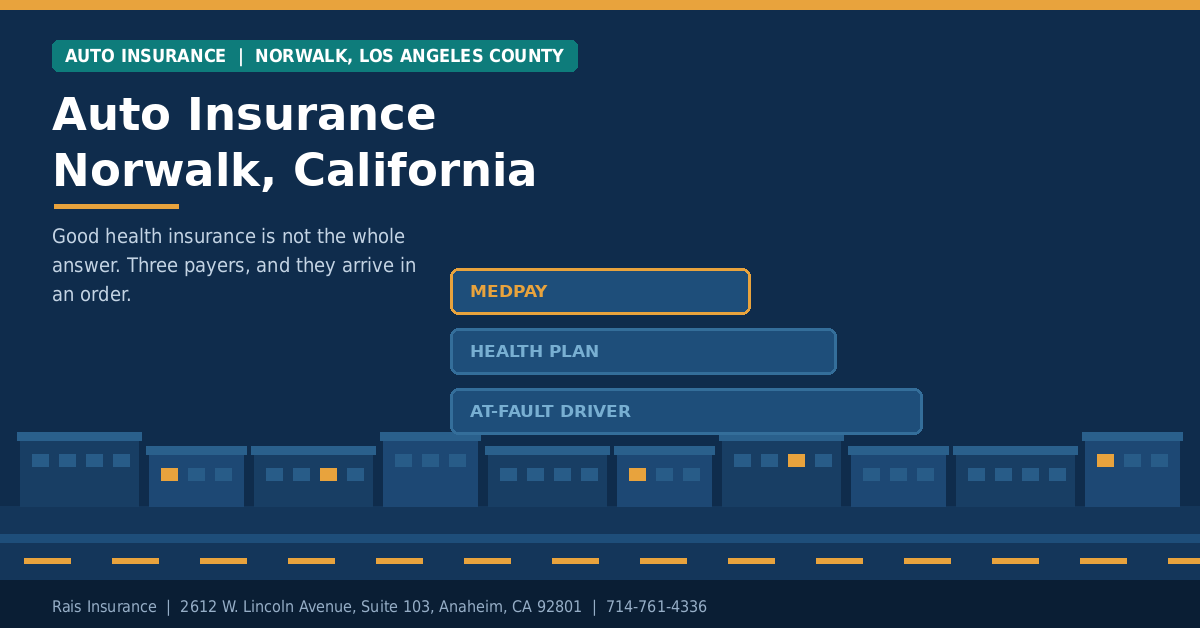
But car insurance policies are not all the same, and how much auto insurance you need depends on the car, your experience and what you can afford. The part worth getting right is which car insurance coverages do which job – because two of them overlap with something you may already have.
Liability Coverage – the Required Layer
Liability is the most basic auto insurance coverage a policy contains, and the one California requires. If you cause an accident through negligence, it pays the medical and vehicle damage the other party suffers, so those costs do not come out of your pocket. That description in the original is accurate.
So is the sentence after it: your own damages and injuries are not covered by liability alone. That is the single most important thing to understand about it, and this page states it plainly where many do not.
Two additions. Liability comes in two required halves – bodily injury liability and property damage liability – and both are mandatory here. And the coverage the original later calls “third-party damages” is liability; it appears under additional coverage on the original, but it is the required layer described in this section. See whose injuries each coverage pays for.
How Fault Is Actually Decided
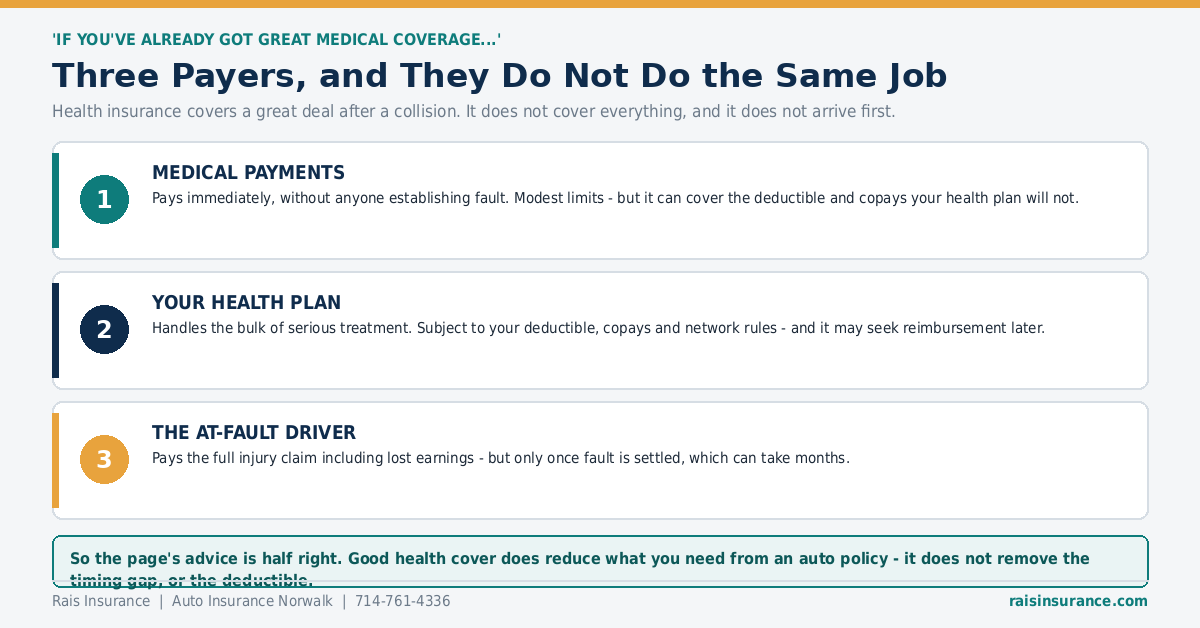
The original says insurers determine fault from witness accounts, and that whoever was most at fault covers the costs. Both parts need adjusting:
- Witness accounts are one input among several. Adjusters work from photographs, the police report where one exists, statements from both drivers, physical damage patterns and increasingly dashcam footage.
- And nobody is simply ‘most at fault’. California uses pure comparative fault – responsibility is apportioned as a percentage. 70/30 and 60/40 are far more common outcomes than 100/0, each side is liable for its share, and there is no cut-off, so even a driver mostly at fault still recovers something.
The full process – who decides, what evidence they use, and what you can do at the scene – is on our how fault is actually decided page.
What Pays Your Medical Bills
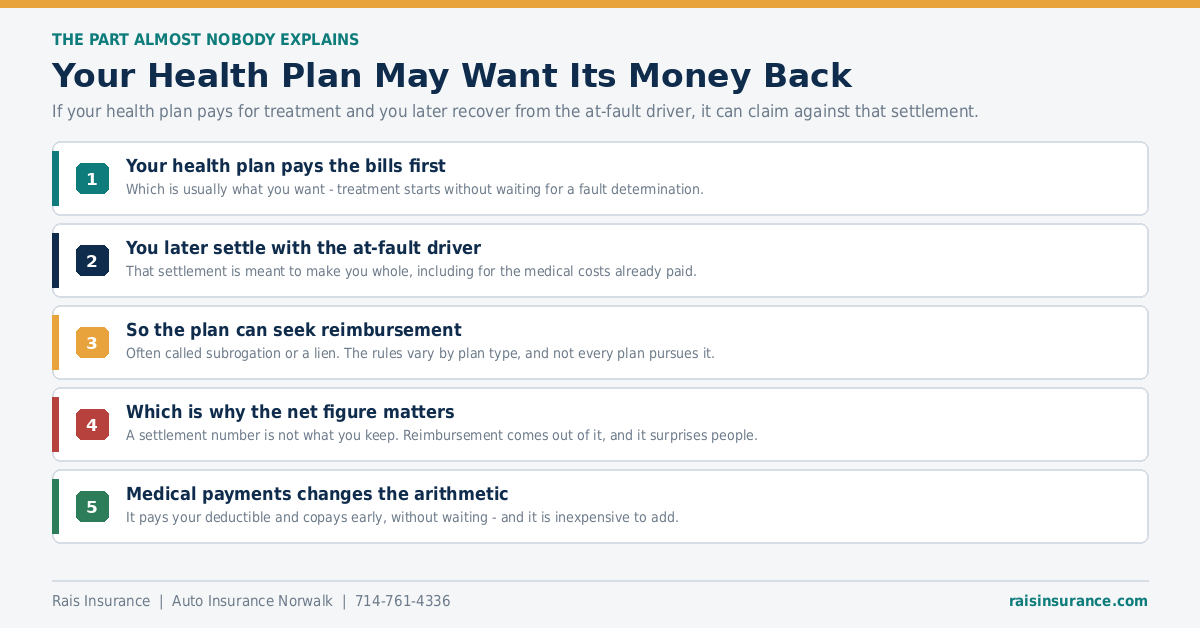
The original closes with a reasonable-sounding piece of advice: if you already have good medical cover, you will not need additional help from your car insurance. That is half right, and the missing half is worth understanding, because up to three payers are involved and they do different jobs:
- Medical payments coverage pays immediately, without anyone establishing fault. The limits are modest, but it can cover the deductible and copays your health plan leaves with you.
- Your health plan handles the bulk of serious treatment – subject to its deductible, copays and network rules.
- The at-fault driver’s bodily injury liability covers the full injury claim including lost earnings, but only once fault is settled, which can take months.
So good health cover genuinely does reduce what you need from an auto policy. What it does not remove is the timing gap – the months before anyone else pays – or your own deductible. Both are exactly what medical payments is for, and it is one of the cheaper things on a policy.
The part almost nobody explains
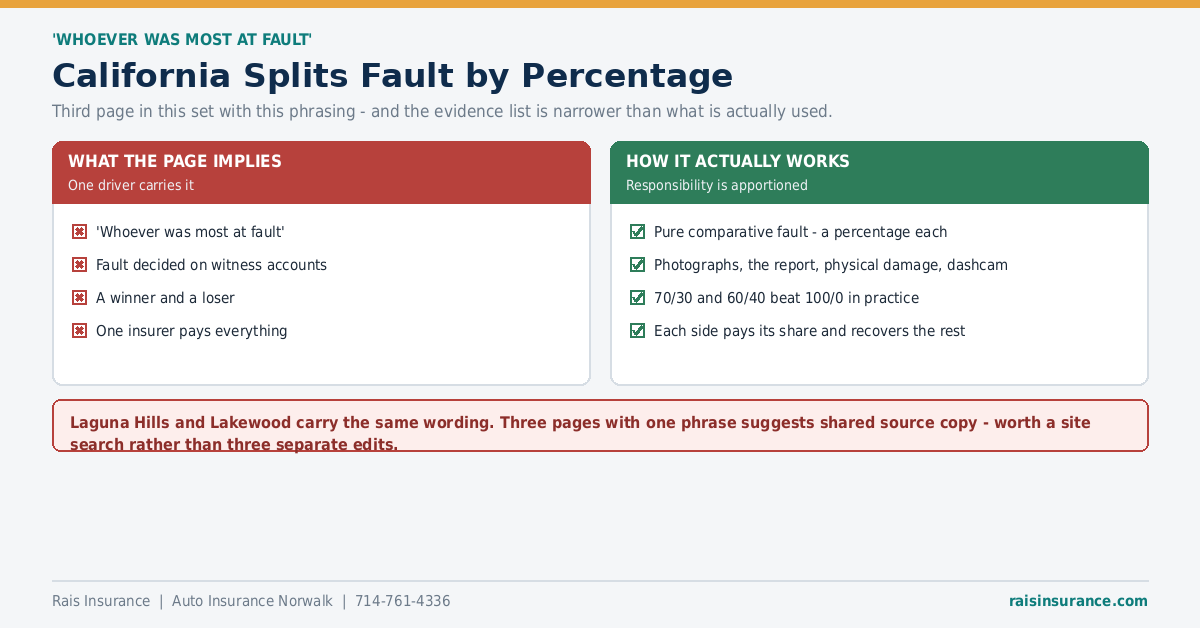
There is a further wrinkle that changes the arithmetic:
- Your health plan pays the bills first, which is usually what you want – treatment starts without waiting for a fault determination.
- You later settle with the at-fault driver, and that settlement is meant to make you whole, including for medical costs already paid.
- So the plan may seek reimbursement from that settlement – often called subrogation, or a lien. The rules vary by plan type and not every plan pursues it.
- Which means a settlement figure is not what you keep. Reimbursement comes out of it, and it surprises people who assumed the two systems did not interact.
None of this is a reason to avoid using your health plan. It is a reason to know that “I have good medical cover” is not a complete answer to the question the page is asking.
The Other Coverages
The original describes these auto insurance coverages accurately and they are kept:
- Collision covers damage to your own vehicle after a crash, regardless of fault and subject to your deductible.
- Comprehensive covers damage from things other than a collision – theft and vandalism, and also fire, weather, falling objects and animal strikes: see what comprehensive coverage actually covers.
- “Medical coverage” is properly called medical payments, which is worth knowing because you have to ask for it by name.
One coverage is missing from the list: uninsured motorist and underinsured motorist cover. It is optional in California, a carrier must obtain your decline in writing, and it matters here specifically – because everything above about the at-fault driver paying assumes they have insurance to pay with.
How Much Coverage You Need
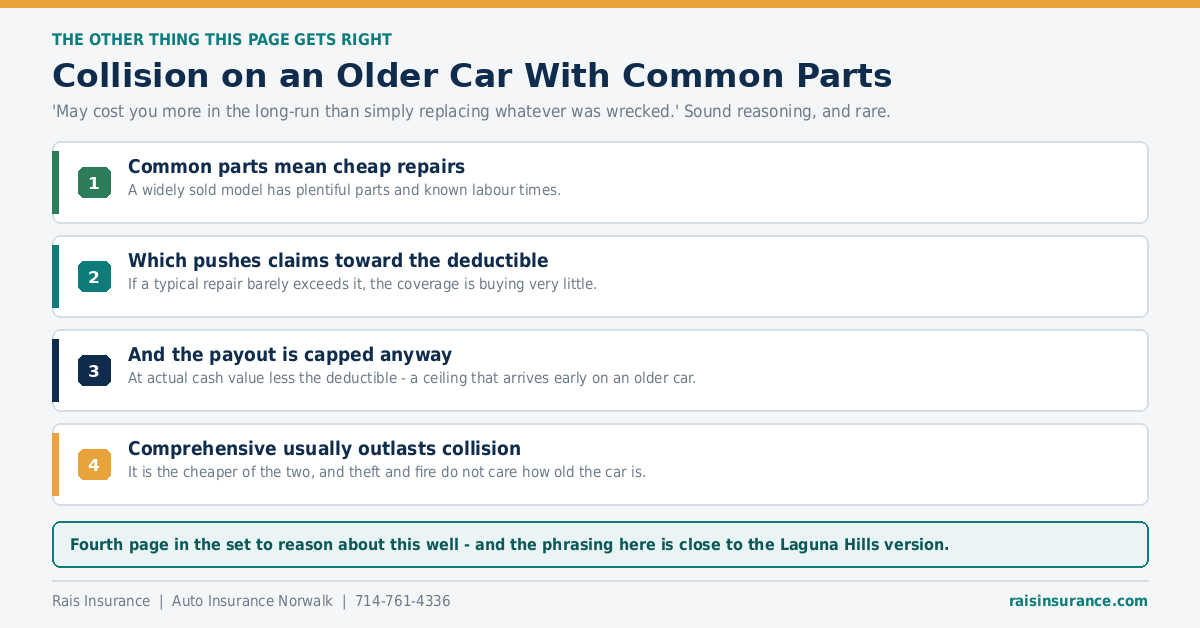
The original’s reasoning on older vehicles is sound and is kept: on a car with common replacement parts, collision may cost more over time than the repairs it would pay for. Expanded slightly:
- Common parts mean cheaper repairs, which pushes a typical claim toward your deductible – and if it barely exceeds it, the coverage is buying very little.
- The payout is capped anyway, at actual cash value less the deductible, and that ceiling arrives earlier than people expect: see when collision and comprehensive stop earning their premium.
- Comprehensive usually outlasts collision, because it is the cheaper of the two and theft and fire do not care how old the car is.
Driving in Norwalk
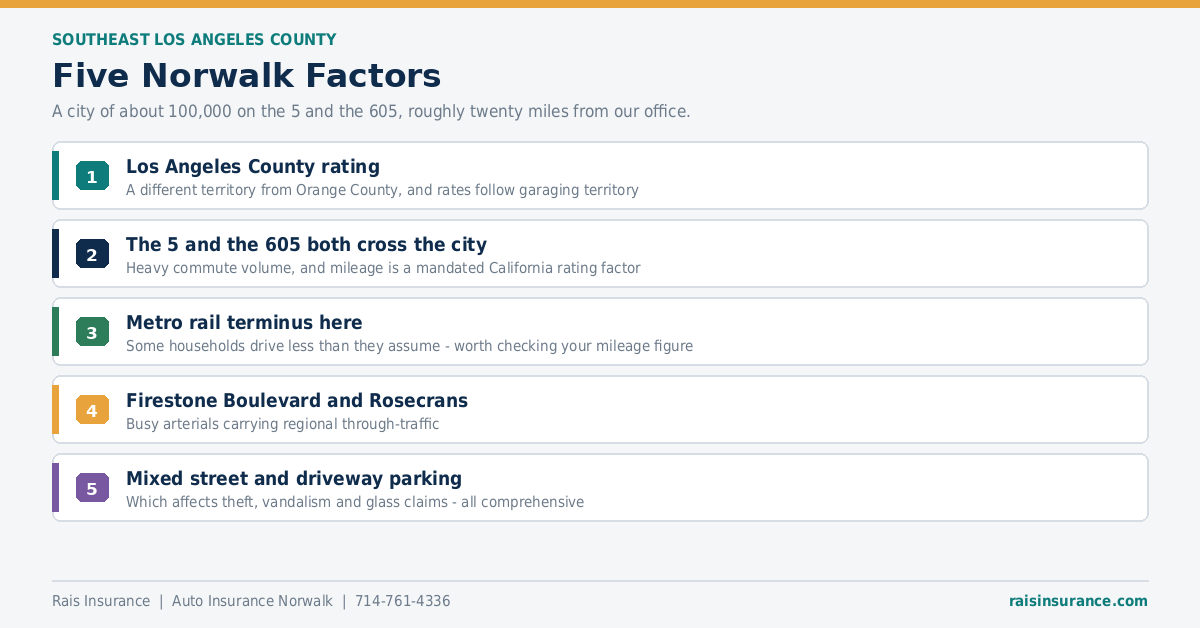
Five things that shape car insurance Norwalk rates specifically, on top of the auto insurance Norwalk basics above:
- Los Angeles County rating. A different territory from Orange County, and California rates by garaging territory rather than city name.
- The 5 and the 605 both cross the city, and annual mileage is one of the three factors state law requires to weigh most heavily.
- A Metro rail terminus here, which means some households drive less than they assume – worth checking the mileage figure on your policy.
- Firestone Boulevard and Rosecrans, busy arterials carrying regional through-traffic.
- Mixed street and driveway parking, which affects theft, vandalism and glass claims.
Building the Policy Around You
The original’s offer is the right one – car insurance that protects you without damaging you financially. What that means in practice is deciding each part deliberately rather than accepting a default, and being honest about what you already have cover for elsewhere.
As an independent broker we place business across a panel of carriers rather than selling one company’s products, so one set of details gets quoted several times – see the insurance companies we represent. We are not an insurance company; the carrier issues the policy and pays the claim, and there is no fee to you for the comparison. The current minimum requirements are on our auto insurance in California page.
Auto Insurance in Norwalk – Frequently Asked Questions
Q1. If I have good health insurance, do I still need medical payments cover?
Usually yes, for two reasons the original version of this page does not mention. First, timing: medical payments pays straight away without anyone establishing fault, while a claim against the at-fault driver can take months. Second, your health plan has a deductible and copays – medical payments can cover those, which is often exactly the gap people feel.
Q2. Who pays my medical bills after a collision?
Up to three payers, doing different jobs. Medical payments coverage pays immediately without a fault determination. Your health plan handles the bulk of serious treatment, subject to its deductible and network rules. And the at-fault driver’s bodily injury liability covers the full claim including lost earnings – but only once fault is settled.
Q3. Can my health plan claim money back from my settlement?
Often, yes. If your health plan pays for treatment and you later recover from the at-fault driver, it may seek reimbursement from that settlement – sometimes called subrogation or a lien. The rules vary by plan type and not every plan pursues it, but it means a settlement figure is not simply what you keep.
Q4. Does medical payments cover my health insurance deductible?
Yes, that is one of the more useful things it does. It can pay the deductible and copays your health plan leaves with you, and it does so without waiting for fault to be resolved. The limits are modest and the coverage is inexpensive, which is why it is worth carrying even alongside good health cover.
Q5. How is fault determined in a car accident?
By an insurance adjuster in almost every case, working from photographs, the police report where one exists, statements from both drivers, physical damage patterns and increasingly dashcam footage. The original version of this page mentions witness accounts, which contribute – but they are one input among several.
Q6. Does one driver carry all the fault?
Rarely. California uses pure comparative fault, which apportions responsibility as a percentage – 70/30 and 60/40 are far more common outcomes than 100/0. Each side is liable for its share and recovers the rest, and there is no cut-off, so even a driver mostly at fault recovers something.
Q7. Do I need collision coverage on an older car?
The original reasons about this well: on an older vehicle with common replacement parts, collision may cost more over time than the repairs it would pay for. The payout is capped at actual cash value less your deductible, so as the car’s value falls the coverage buys progressively less. Comprehensive usually keeps earning its premium longer.
Q8. What is ‘third-party damage’?
It is not standard American wording – here it is called liability coverage, and it means damage and injury you cause to other people. The original lists it under additional coverage, but it is the required coverage the page describes in its own previous section.
Q9. Do I need uninsured motorist coverage?
It is optional in California and a carrier must obtain your decline in writing. It responds when the at-fault driver has no insurance or not enough of it – which matters particularly here, because everything on this page about the at-fault driver paying assumes they have coverage to pay with.
Q10. How do I get a Norwalk auto insurance quote?
Call Rais Insurance on 714-761-4336 or email rai@raisinsurance.com. Our office is in Anaheim, about twenty miles away. We are an independent broker, so one set of details is quoted across several carriers, and there is no fee to you for the comparison.
Get a Car Insurance Quote in Norwalk
contact Rais Insurance on 714-761-4336 or email rai@raisinsurance.com.
If you are weighing car insurance medical payments against the health cover you already hold, tell us what your health plan deductible is. That one number usually settles the question faster than any general advice can.
