

Auto Insurance Norco California
Auto insurance for Norco drivers, quoted across several carriers by Rais Insurance.Our aim is to make sure you understand your options before you choose between them – which means being clear about what actually moves the price of auto insurance Norco drivers pay, and what does not. Every auto insurance norco quote we prepare starts by sorting out which factors actually move the number.
That second part matters more than it sounds, because California car insurance rules prohibit two of the factors most commonly cited in advice about lowering premiums. It also runs a low cost programme that hardly anybody knows about. That’s the standard we hold every car insurance norco policy to — facts you can act on, not the usual advice column list.
What Actually Sets Your Rate
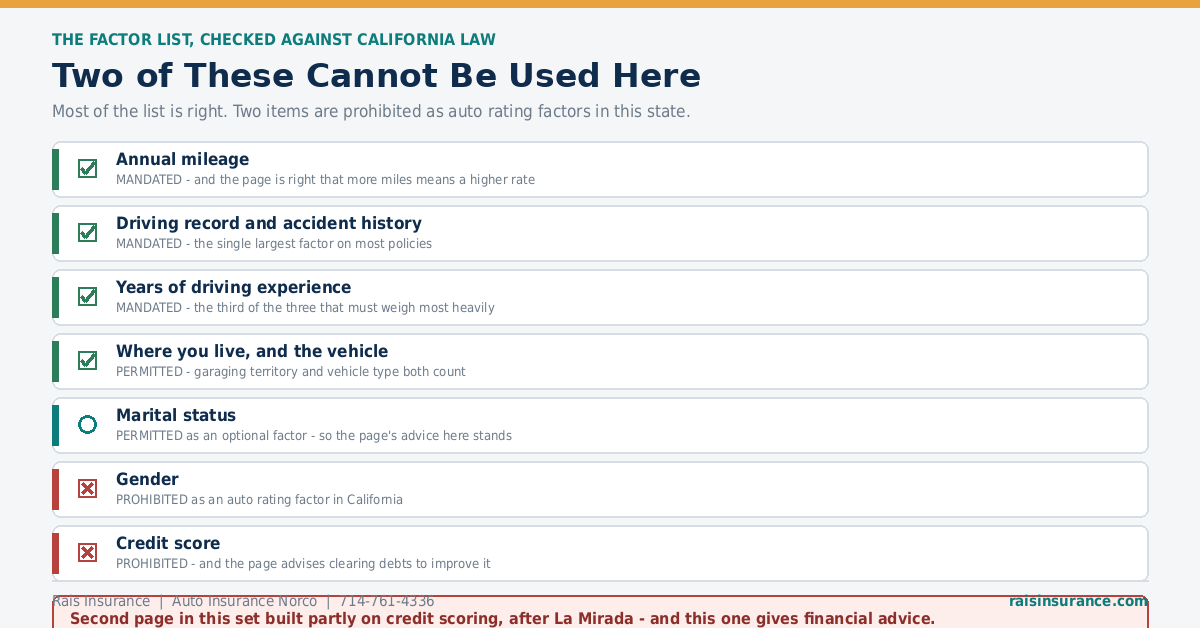
Most of the car insurance factors the original version of this page lists are right. Two are not usable here at all:
- Annual mileage – correct, and the page is right that more miles means a higher rate. It is one of three factors state law requires to weigh most heavily.
- Driving record and accident history – also mandated, and usually the largest single factor on a policy. The page is right that a DUI is a serious mark, and it is one of the few things that can move a premium sharply in one step.
- Years of driving experience – the third mandated factor.
- Where you live and the vehicle you drive – both permitted. Rates are set by garaging territory rather than city name.
- Marital status – permitted as an optional factor, so the page’s advice to tell us about a recent marriage stands.
- Gender – prohibited as an auto rating factor in California.
- Credit score – prohibited too. Repairing your credit is worth doing for other reasons, but it will not change what you are quoted here.
The full picture of what California requires and forbids is on our what determines your premium in California page. It’s the kind of detail worth checking on any car insurance in norco, ca policy before assuming a factor applies here the way it might elsewhere.
What You Can Actually Change
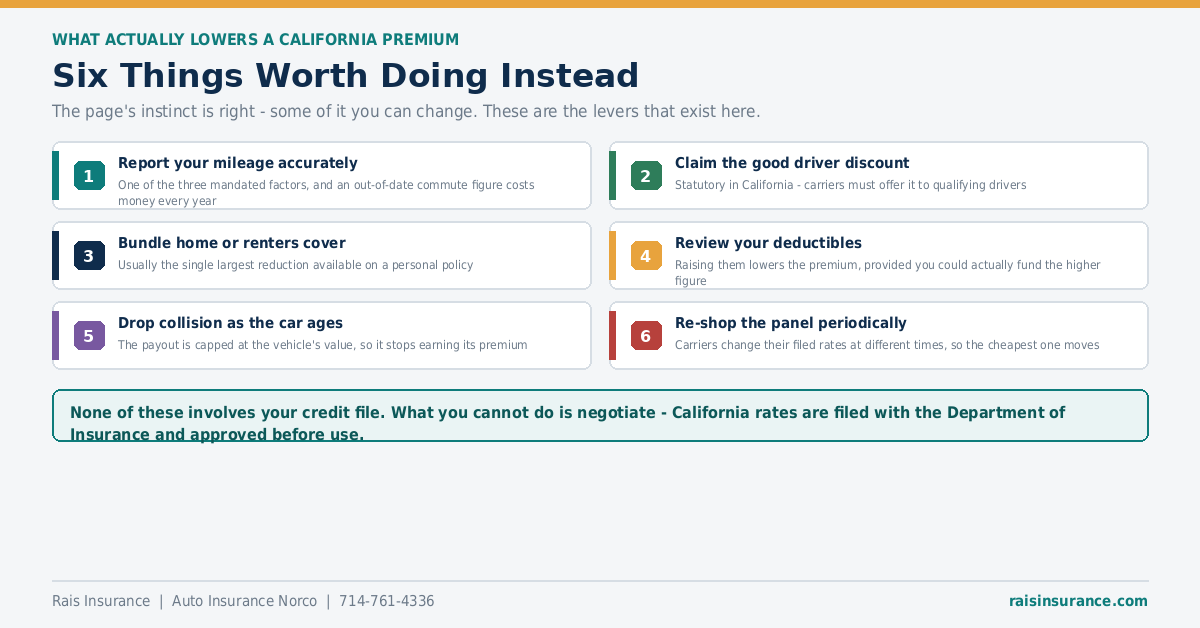
The original’s instinct is right – some of this you can influence. Six things that genuinely work here:
- Report your mileage accurately. A commute figure from three jobs ago costs money every year, and mileage is one of the mandated three.
- Claim California’s good driver discount, which is statutory – carriers must offer it to qualifying drivers.
- Bundle home or renters cover, usually the single largest reduction available on a personal policy.
- Review your deductible. Raising each deductible lowers the premium, provided you could genuinely fund the higher figure at short notice.
- Drop collision once the car’s value no longer justifies it – see when collision and comprehensive stop earning their premium.
- Re-shop periodically. Carriers change their filed rates at different times, so the cheapest one moves.
The page is also right that safety features help – vehicle type is a permitted factor, and a car with a strong safety record generally rates better. What you cannot do is negotiate: California rates are filed with the Department of Insurance and approved before use, so no agent can price below a carrier’s filed rate for your profile. Every one of our auto insurance quotes in norco, ca starts from that same list of six levers, not a generic discount pitch.
Adding a teenage driver
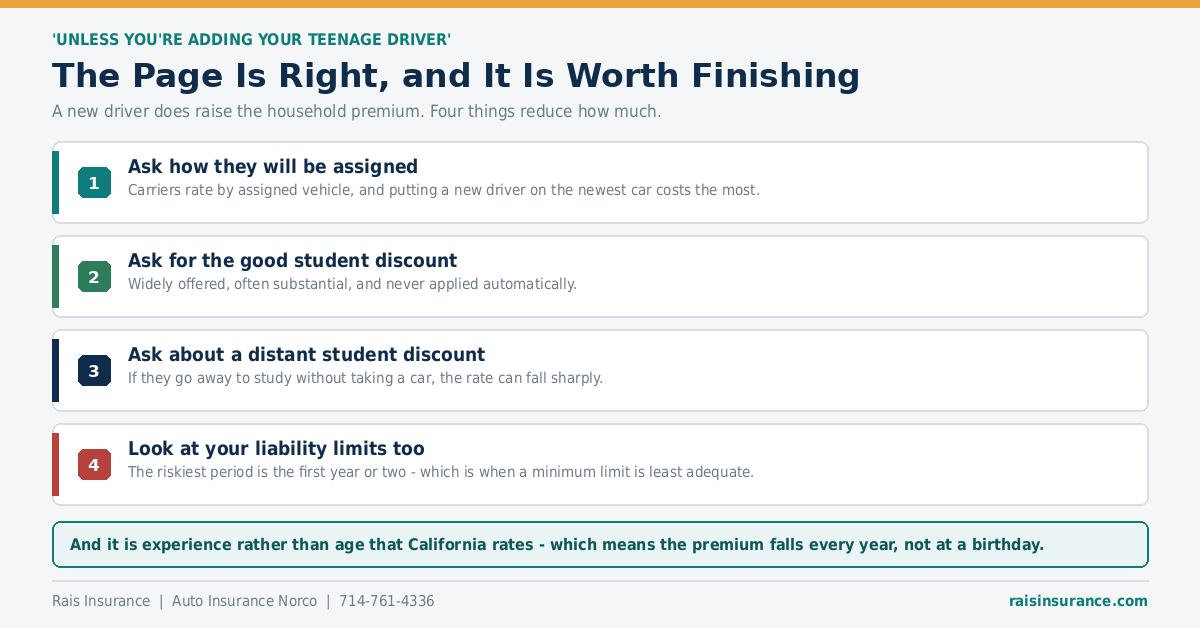
The original mentions this in passing and it deserves more, because it is the single largest change most households will see. Four things reduce how much:
- Ask how they will be assigned to a vehicle. Carriers rate by assigned car, and putting a new driver on the household’s newest one costs the most.
- Ask for the good student discount – widely offered, often substantial, never applied automatically.
- Ask about a distant student discount if they go away to study without taking a car.
- Look at your liability limits at the same time, because the riskiest period is exactly when a minimum limit is least adequate: see how liability limits actually work.
Worth knowing too that California rates on years of experience rather than age as such – so the premium falls progressively as a young driver builds a clean record, rather than dropping at some particular birthday. More on this on our adding a young driver to your policy page. It’s the one gap auto insurance in norco, ca households most often overlook until the renewal notice arrives.
California’s Low Cost Auto Insurance Programme
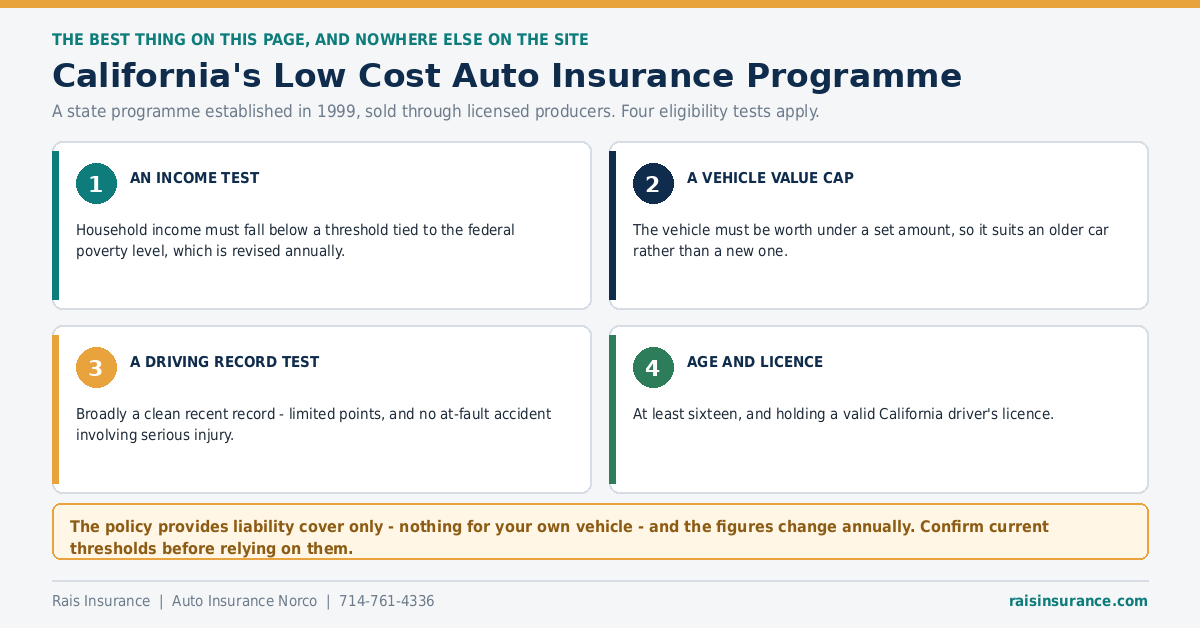
This is the most useful thing on the original page, and it is worth setting out properly. CLCA was established in 1999 to make liability cover available to lower-income drivers. It is a state programme sold through licensed producers rather than by the state directly – and it is available statewide, not just here.
Four eligibility tests apply:
- An income test. Household income must fall below a threshold tied to the federal poverty level.
- A vehicle value cap. The car must be worth under a set amount, which suits an older vehicle rather than a recent one.
- A driving record test. Broadly a clean recent record – limited points, and no at-fault accident involving serious injury.
- Age and licence. At least sixteen, and holding a valid California driver’s licence.
Two things to understand before pursuing it. The policy provides liability cover only – there is nothing for your own vehicle, so no collision or comprehensive, which also makes it unsuitable for a financed car where a lender requires physical damage cover. And the figures are revised periodically, with the income threshold following annual updates to the federal poverty level.
If it might apply to your household, ask us and we will check the current thresholds with you rather than leaving you to work through it alone. That’s the same check we run on every car insurance quotes in norco, ca request, whether or not the programme ends up being the right fit.
Driving in Norco
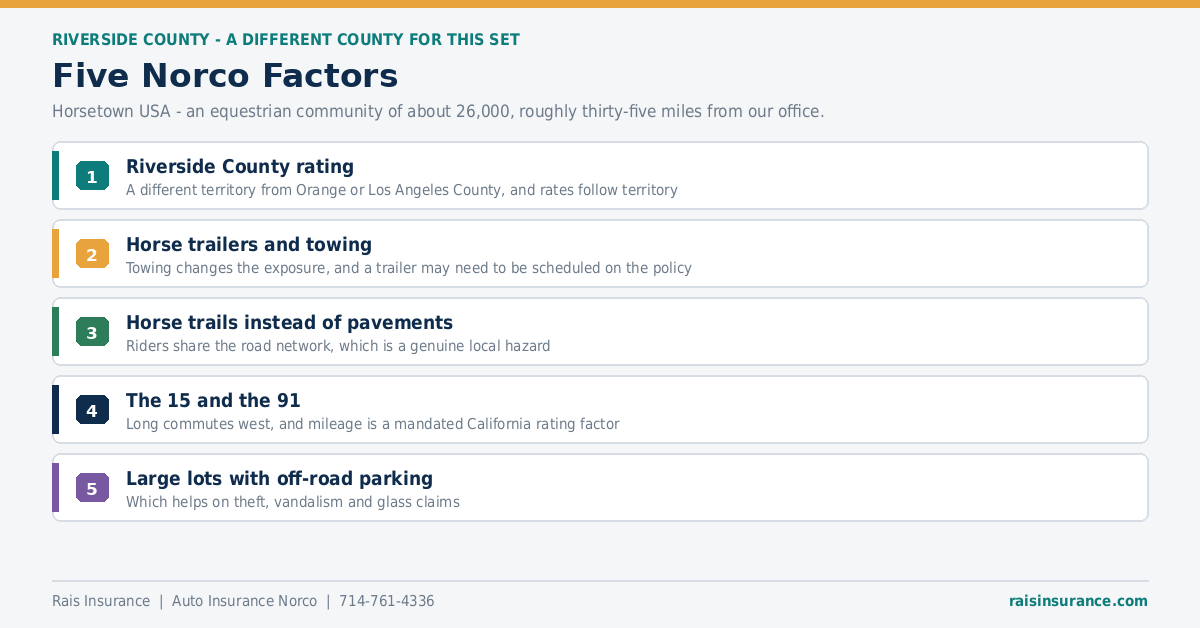
Five things that shape car insurance Norco rates specifically, on top of the auto insurance Norco basics above:
- Riverside County rating. A different territory from Orange or Los Angeles County, and California rates by garaging territory.
- Horse trailers and towing. Towing changes the exposure while it is happening, and a trailer may need to be scheduled on the policy rather than assumed to be covered.
- Horse trails instead of pavements. Riders share the road network here in a way they do not in most cities, which is a genuine local consideration.
- The 15 and the 91, and annual mileage is one of the three factors California law requires to weigh most heavily.
- Large lots with off-road parking, which helps on theft, vandalism and glass claims. These five factors are exactly what we account for when quoting auto insurance norco for a specific address.
Getting Adequate Coverage at a Sensible Price
Cheap car insurance and thin cover are not the same thing, and the original is right to separate them. The work is deciding each part deliberately – your liability limits, which optional coverages you carry, your deductible, and which carrier writes the policy. It’s worth asking about renters insurance in norco, ca at the same time, since bundling is usually the single largest reduction available.
One coverage worth checking on your current policy: uninsured motorist and underinsured motorist cover. It is optional in California, a carrier must obtain your decline in writing, and it responds when the at-fault driver has no insurance or not enough of it.
As an independent broker we place business across a panel of carriers rather than selling one company’s products, so one set of details gets quoted several times – see the insurance companies we represent. We are not an insurance company; the carrier issues the policy and pays the claim, and there is no fee to you for the comparison. The current minimum requirements are on our auto insurance in California page. We can put together norco, ca renters insurance quotes alongside your auto policy in the same call, so you’re comparing the full picture.
Auto Insurance in Norco – Frequently Asked Questions
Q1. What is California’s Low Cost Auto Insurance programme?
A state programme established in 1999 to make liability cover available to lower-income drivers, sold through licensed producers rather than by the state directly. It is available statewide rather than in particular cities. Four tests apply: a household income limit tied to the federal poverty level, a cap on the vehicle’s value, a broadly clean recent driving record, and being at least sixteen with a valid California licence.
Q2. What does the low cost programme actually cover?
Liability only – it meets the state requirement to cover injuries and property damage you cause to other people. It does not cover your own vehicle, so there is no collision or comprehensive under it. That makes it well suited to an older car and poorly suited to a financed one, where a lender will require physical damage cover.
Q3. Do the income and vehicle value limits change?
Yes, they are revised periodically – the income threshold tracks the federal poverty level, which is updated annually. It is worth confirming the current figures before relying on them, and we can check eligibility with you rather than have you work through it alone.
Q4. Does my credit score affect my car insurance in California?
No. Credit-based insurance scores are prohibited as a rating factor in California private passenger auto insurance. Repairing your credit is worth doing for other reasons, but it will not change what you are quoted here – which makes it different from most other states, where credit often carries substantial weight.
Q5. Does gender affect my rate?
No. Gender was removed as a permitted auto rating factor in California. Marital status, on the other hand, is still a permitted optional factor – so the original version of this page is right that telling us about a recent marriage is worth doing.
Q6. What does California require carriers to weigh most heavily?
Three factors: your driving safety record, your annual miles driven, and your years of driving experience. Every other permitted factor must carry less weight than those three. The page is right that more miles means a higher rate – mileage is one of the mandated three. That’s the baseline every car insurance in norco, ca policy should be checked against before assuming any other factor outweighs it.
Q7. What actually lowers a premium here?
Reporting your mileage accurately, claiming California’s statutory good driver discount, bundling home or renters cover, reviewing your deductibles, dropping collision once a vehicle’s value no longer justifies it, and re-shopping the market periodically because carriers change their filed rates at different times. That’s the same list every car insurance quotes in norco, ca comparison should include, lever by lever.
Q8. Can I negotiate a lower rate?
No. California carriers file their rates with the Department of Insurance and must have them approved before use, so nobody can price below a carrier’s filed rate for your profile. What a broker changes is placement – which carrier’s filed rates suit you – and making sure every discount you qualify for is actually applied. It’s the same discipline behind every auto insurance quotes in norco, ca request we handle, regardless of which carrier ends up writing it.
Q9. Will adding a teenage driver raise my premium?
Yes, and the original is right to flag it. Four things reduce how much: ask how the new driver will be assigned to a vehicle, ask for the good student discount, ask about a distant student discount if they go away to study without a car, and look at your liability limits at the same time – the riskiest period is exactly when a minimum limit is least adequate. That’s the review worth doing on any auto insurance in norco, ca policy the moment a new driver gets added.
Q10. How do I get a Norco auto insurance quote?
Call Rais Insurance on 714-761-4336 or email rai@raisinsurance.com. Our office is in Anaheim, about thirty-five miles west, so Norco is served by phone and email. We are an independent broker, so one set of details is quoted across several carriers – and if the low cost programme might fit, we can check that with you too. That’s the fastest way to get a car insurance norco quote built around your actual household, not a generic estimate.
Get a Car Insurance Quote in Norco
contact Rais Insurance on 714-761-4336 or email rai@raisinsurance.com. Our office is in Anaheim, about thirty-five miles west, so Norco is served by phone and email. If you rent rather than own, ask about renters insurance in norco, ca in the same call — it often bundles neatly with your auto policy.
Two things worth mentioning at the start: your actual annual mileage rather than an estimate, and whether you tow anything. Both change the quote in ways that are much better handled now than discovered later. Ask us for norco, ca renters insurance quotes at the same time if it’s relevant — it’s one more discount most people never think to ask about.
