

Auto Insurance Mission Viejo California
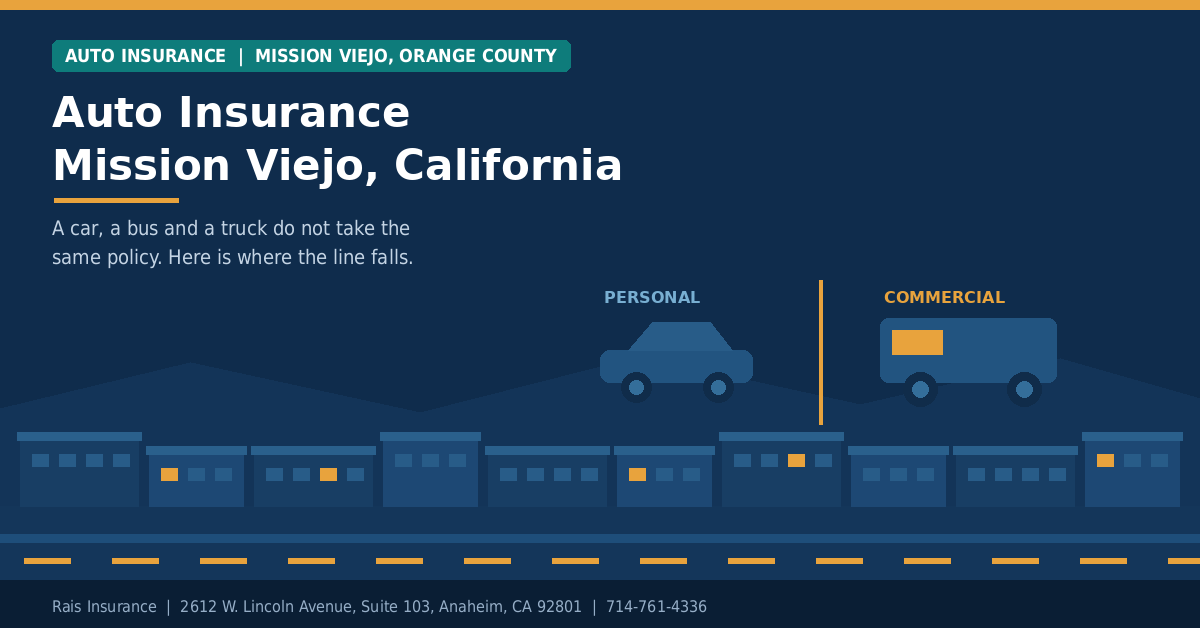
The original version of this page opens with a useful definition: insurance you buy for your car, bus or truck, protecting against monetary loss from traffic accidents and unforeseen events like theft or natural calamity. That is right – and the three vehicles in it do not all take the same policy, which is where this page starts.
A Car, a Bus and a Truck Are Not the Same Policy
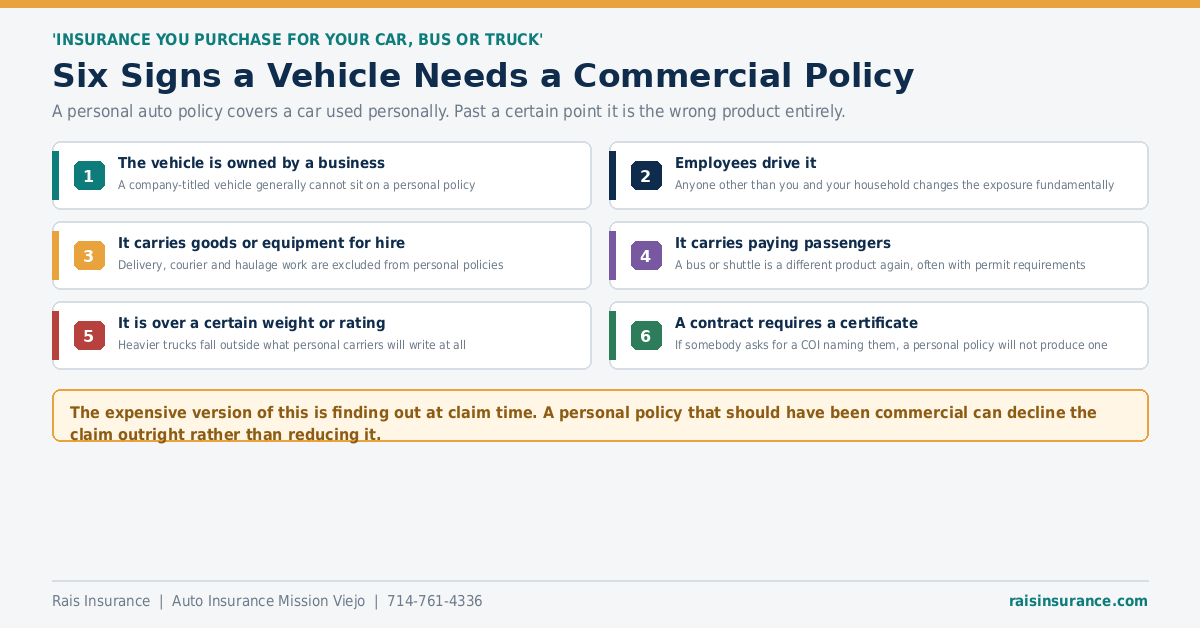
A personal car insurance policy contemplates a car used personally, by you and your household. Past a certain point it is not merely more expensive – it is the wrong product. Six things usually move a vehicle onto a commercial auto insurance policy:
- The vehicle is owned by a business rather than an individual. A company-titled vehicle generally cannot sit on a personal policy at all.
- Employees drive it. Anyone beyond you and your household changes the exposure fundamentally.
- It carries goods or equipment for hire – delivery, courier and haulage work are excluded from personal policies.
- It carries paying passengers. A bus or shuttle is a different product again, often with permit requirements attached.
- It exceeds the weight or rating a personal carrier will write.
- A contract requires a certificate of insurance naming somebody else. A personal policy will not produce one.
The expensive version of this is discovering it at claim time, because a personal policy that should have been commercial can be declined outright rather than reduced. If a vehicle sits anywhere near that line, it is worth quoting both ways before the loss rather than after – and we place both.
The Four Coverages, Checked
The original lists four auto insurance coverages. One is entirely correct, and the other three each need a small correction – two of which change what a reader would expect at claim time.
Liability – two corrections and one thing it gets right
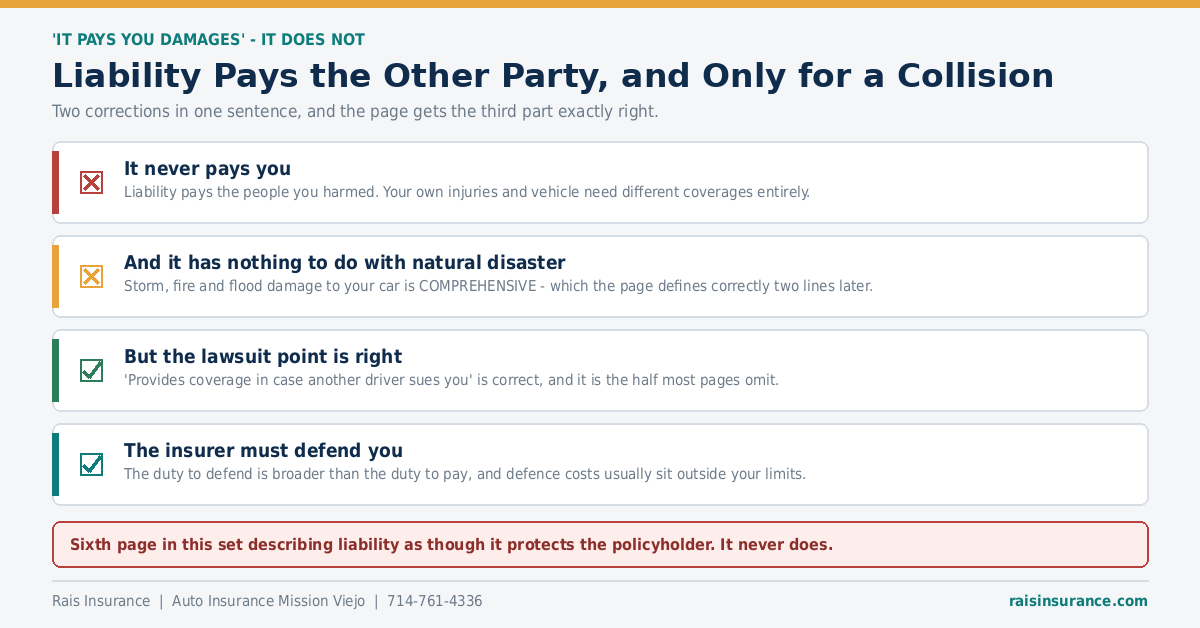
The page says liability “pays you damages in case of an accident or natural disaster”. Two things there:
- It never pays you. Liability pays the people you harm – their injuries and their property. Your own injuries need medical payments, your health plan or uninsured motorist cover; your own vehicle needs collision or comprehensive. See whose injuries each coverage pays for.
- And it has nothing to do with natural disaster. Storm, fire and flood damage to your car is comprehensive – which the page itself defines correctly two lines further down.
But the third part is right, and most pages leave it out: liability provides coverage in case another driver sues you. The insurer’s duty to defend is broader than its duty to pay, so even a weak claim gets defended – and on a personal policy those defence costs generally sit outside your limits.
Comprehensive – correct as written
“Protects you in case your car is stolen or damaged through vandalism or natural disaster.” Accurate, and kept. It also covers fire, falling objects, glass and animal strikes – see what comprehensive coverage actually covers.
Collision – and the animal that is in the wrong section
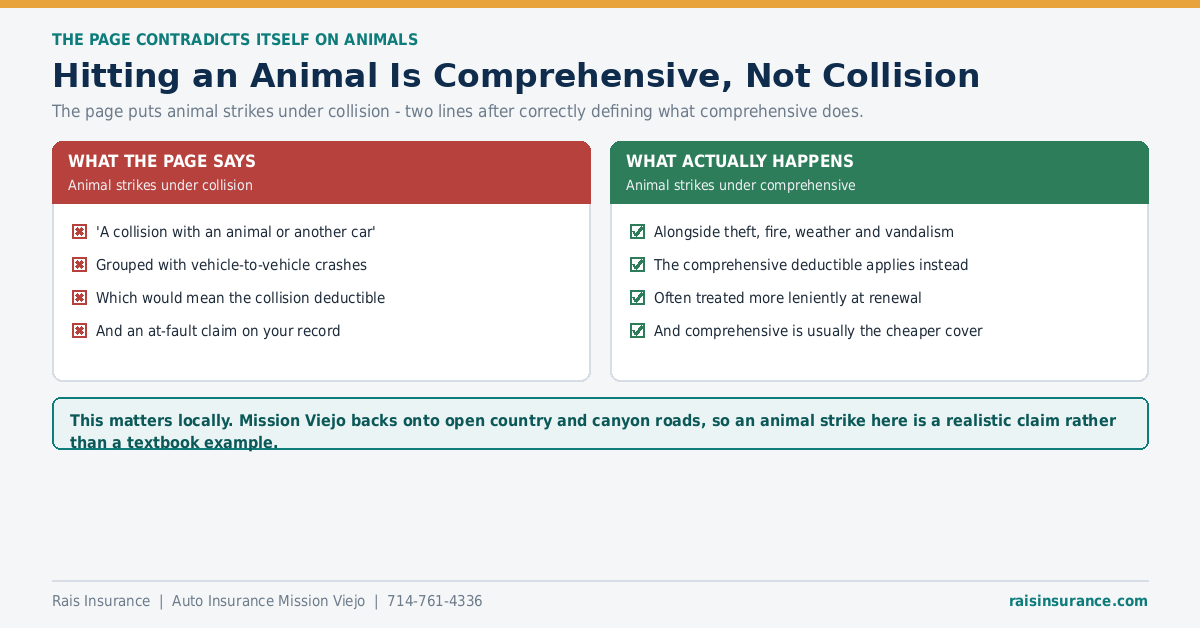
The page says collision pays “the full cost of any damage to your car if involved in a collision with an animal or another car”, and that you are paid even if the crash was your fault. That last part is exactly right and is the single most useful thing on the page – collision is the coverage that responds regardless of who caused it.
Two corrections though:
- Not the full cost. Collision pays up to the vehicle’s actual cash value, less your deductible: see when collision and comprehensive stop earning their premium.
- And hitting an animal is comprehensive, not collision. It sits with theft, fire and weather rather than with vehicle-to-vehicle crashes – which means a different deductible and, usually, gentler treatment at renewal.
That correction matters more here than in most cities. Mission Viejo backs onto open country and canyon roads, so an animal strike is a realistic claim rather than a textbook example.
Uninsured and underinsured – one word to change
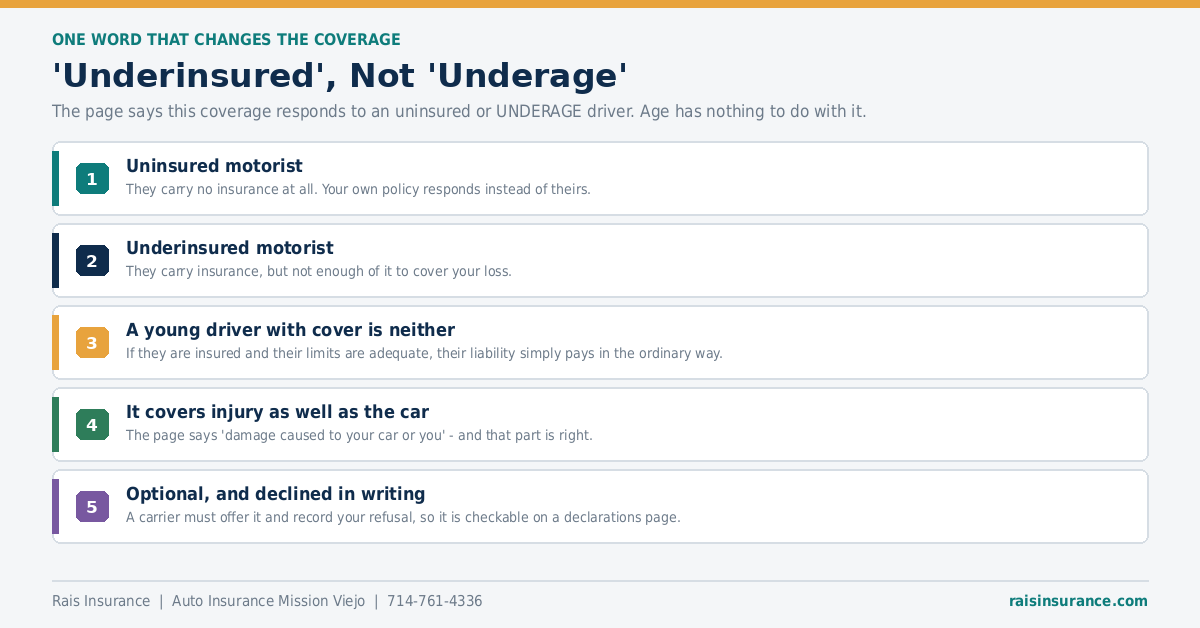
The page describes protection against “an uninsured or underage driver”. It should read underinsured, and the difference is not cosmetic:
- Uninsured motorist responds when the other driver carries no insurance at all.
- Underinsured motorist responds when they carry some, but not enough for your loss.
- A young driver with adequate cover is neither. Age is irrelevant here – if they are insured and their limits are sufficient, their liability simply pays in the ordinary way.
The page is right that it covers “damage caused to your car or you” – both, in most policies. Both are optional in California, and a carrier must obtain your decline in writing, so it is checkable on your declarations page.
Driving in Mission Viejo
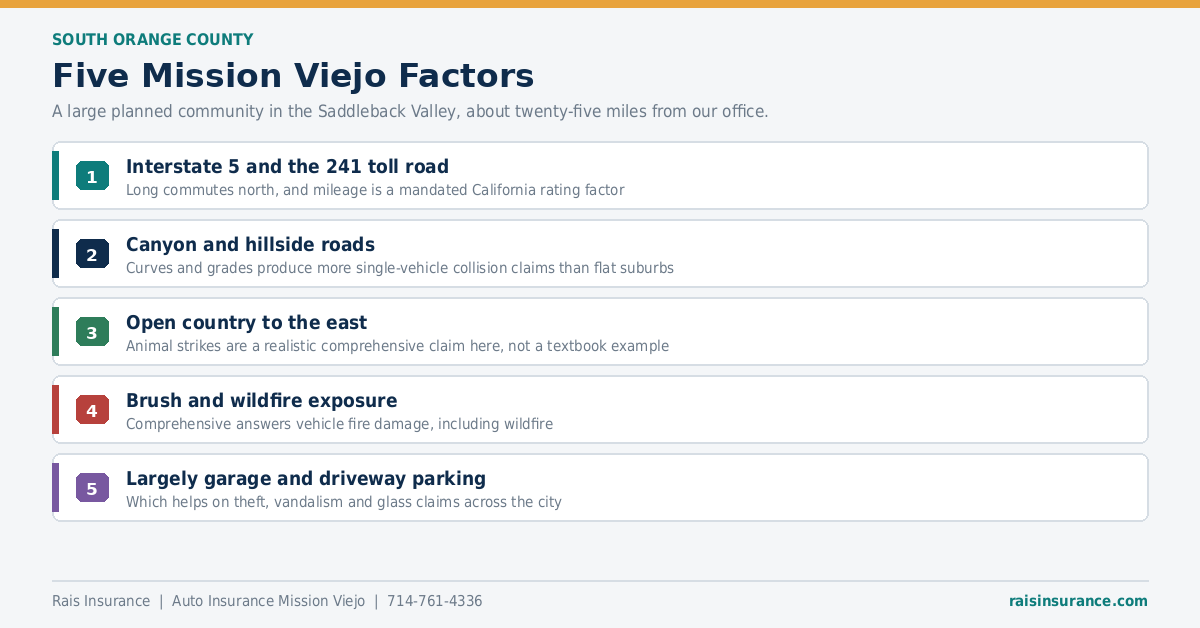
Five things that shape car insurance Mission Viejo rates specifically, on top of the auto insurance Mission Viejo basics above:
- Interstate 5 and the 241 toll road. Long commutes north, and annual mileage is one of the three factors California law requires to weigh most heavily.
- Canyon and hillside roads, where curves and grades produce more single-vehicle collision claims than flat suburban driving. How fault gets apportioned in those is on our how fault is actually decided page.
- Open country to the east, which is what makes the animal strike point above locally relevant.
- Brush and wildfire exposure, which comprehensive answers.
- Largely garage and driveway parking, which helps on theft, vandalism and glass claims across the city.
Why Work With Rais Insurance
The original describes long-term relationships with individual drivers, small companies and large corporations – and that range is the genuinely useful part, given everything above. If a household vehicle starts being used for work, or a business acquires one, the car insurance conversation does not have to start again somewhere else.
As an independent broker we place business across a panel of carriers rather than selling one company’s products, so one set of details gets quoted several times – see the insurance companies we represent. We are not an insurance company; the carrier issues the policy and pays the claim, and there is no fee to you for the comparison.
The current minimum requirements and the full coverage list are on our auto insurance in California page.
Auto Insurance in Mission Viejo – Frequently Asked Questions
Q1. When does a vehicle need commercial auto insurance?
Six situations usually trigger it: the vehicle is owned by a business rather than an individual; employees drive it; it carries goods or equipment for hire; it carries paying passengers; it exceeds the weight or rating a personal carrier will write; or a contract requires a certificate of insurance naming somebody else. Any one of those generally moves you off a personal policy.
Q2. What happens if I use my personal car for business?
It depends on the use. Driving to a fixed workplace is ordinary commuting and fine. Carrying goods for hire, making deliveries, or transporting paying passengers is generally excluded – and the expensive version is finding that out at claim time, because a claim can be declined outright rather than reduced.
Q3. Does my policy cover an employee driving my vehicle?
Generally not on a personal auto policy, which contemplates you and your household rather than staff. If somebody drives your vehicle in the course of a business, that is a commercial exposure and it needs to be written as one. It is a common and expensive assumption.
Q4. Does liability coverage pay me?
No. Liability pays the people you harm – their injuries and their property. Your own injuries need medical payments, your health plan or uninsured motorist cover, and your own vehicle needs collision or comprehensive. The original version of this page says liability ‘pays you damages’, which is the wrong direction.
Q5. Does liability cover storm or natural disaster damage?
No. Damage to your vehicle from storm, fire, flood or falling objects is comprehensive coverage – which the original version of this page defines correctly two lines further down. Liability responds only when you are responsible for harm to somebody else.
Q6. Is hitting an animal a collision or a comprehensive claim?
Comprehensive, which surprises most drivers because it feels like a collision. It usually works in your favour: comprehensive claims are often treated more leniently at renewal than at-fault collision claims, and comprehensive is generally the cheaper of the two coverages. It matters locally, because Mission Viejo backs onto open country.
Q7. Does collision pay the full cost of repairing my car?
Not quite. It pays up to the vehicle’s actual cash value, less your deductible – so ‘the full cost of any damage’ overstates it. The page is right about the important part though: collision pays regardless of fault, including when the crash was your fault.
Q8. What is underinsured motorist coverage?
It responds when the at-fault driver has insurance but not enough of it to cover your loss. Uninsured motorist handles the case where they have none at all. Note the original says ‘uninsured or underage driver’ – age is irrelevant here. A young driver who is properly insured is simply an insured driver.
Q9. Which coverages are actually required in California?
Bodily injury liability and property damage liability. Everything else – collision, comprehensive, medical payments, uninsured and underinsured motorist – is optional, though a lender will usually require collision and comprehensive while a vehicle is financed.
Q10. How do I get a Mission Viejo auto insurance quote?
Call Rais Insurance on 714-761-4336 or email rai@raisinsurance.com. Our office is in Anaheim, about twenty-five miles north. We are an independent broker placing both personal and commercial auto business, so if a vehicle sits near the line between the two we can quote it either way and show you the difference.
Get a Car Insurance Quote in Mission Viejo
contact Rais Insurance on 714-761-4336 or email rai@raisinsurance.com.
If the vehicle is used for anything beyond personal driving on your car insurance – deliveries, client visits with equipment aboard, or anyone outside the household at the wheel – mention it at the start. That is the detail that decides which product applies, and it is far better raised now than tested by a claim.
