

Business Insurance Bellflower California
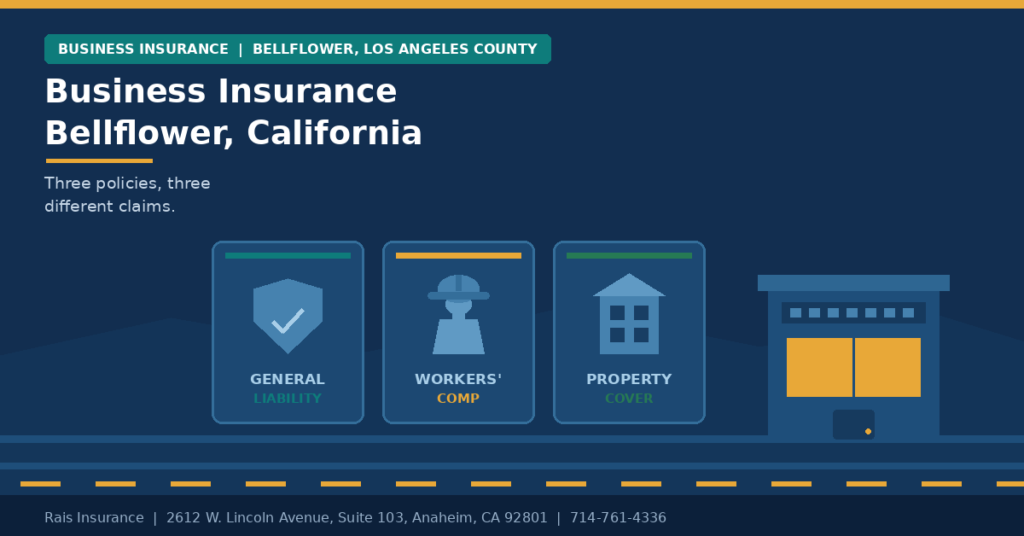
Running a business is largely an exercise in risk management, and the original version of this page puts it well: it is the things you cannot predict that deserve the most attention. Business insurance Bellflower California operators carry is how those things get absorbed rather than survived.
This page also does something none of the other business pages on this site manage — it names three policies and describes each one correctly, including the distinction between liability and workers’ compensation. So rather than replace that, this version builds on it, then covers the cover it leaves out.
General Liability Insurance
The original describes this accurately: it responds to third-party claims for bodily injury or property damage arising from an accident or negligence on the business’s part.
What it covers in practice:
- A customer or visitor injured on your premises.
- Damage your operations cause to somebody else’s property.
- Advertising injury claims, which are bundled into most policies.
- Your legal defence, which the carrier handles alongside the claim — and defence costs are typically paid in addition to your limit rather than eroding it.
One qualification on the original’s wording. It says liability cover protects contractors and entrepreneurs “almost entirely, in some cases.” Every policy has a per-occurrence limit and an annual aggregate, and above those the balance falls on the business. A commercial umbrella adds a further layer above your liability, auto and employers liability limits together, and is usually the least expensive way to buy a meaningful increase.
The original is also right that general liability is the base of almost any business policy. It is the one most leases and client contracts require — more on certificates and additional insured status on our Anaheim business page.
Workers’ Compensation
This section is correct, and worth saying so plainly: the original identifies that workers’ compensation exists for employees while liability covers third parties. That is exactly right, and it is the distinction our Artesia business page had to correct.
Two things to add:
It is legally required in California for essentially any business with even one employee. The penalties for operating without it include stop-work orders and personal exposure for the owner, so it is not a coverage to postpone.
It is a no-fault system. Benefits are paid regardless of whether anyone was careless — and the original’s phrasing, “if the injuries were caused by an accident,” slightly undersells this. An employee generally does not need to establish fault, and in exchange ordinarily cannot sue the business over the injury.
What it pays: medical treatment, wage replacement while the employee cannot work, disability and rehabilitation benefits, and death benefits to dependants. Employers liability sits alongside it and handles the narrow set of employment-related injury claims that fall outside the no-fault system.
Commercial Property Insurance
The original covers this well, with one clarification worth making: property cover matters whether or not you own a lot of property. A small leased office with computers, furniture and stock has real exposure, and the policy applies just as much.
What it covers:
- The building, if you own it — insured for what it would cost to rebuild at today’s prices, not market value and not the purchase price.
- Business personal property — equipment, furniture, fixtures, machinery.
- Inventory and stock.
- Tenant improvements, if you fitted out a leased space. The landlord insures the structure; you insure the fit-out, and most leases say so.
Standard perils include fire, lightning, wind, hail, theft and vandalism — so the original is right about vandalism and destruction. Flood and earthquake are excluded from every standard commercial property policy and available separately.
One correction on the detail: the original says property cover handles “lawsuits due to accidents on your own property.” Those are general liability claims rather than property claims. Property cover pays for damage to your things; liability pays for injury and damage to other people’s. The two sit side by side in most policies, which is where the overlap in wording comes from.
Our Riverside business page covers equipment valuation and crime cover in more depth.
What the Three Do Not Cover
Those three are the core, and they leave a specific gap. Business interruption cover fills it:
- Lost net income while your premises are being repaired after a covered loss.
- Continuing fixed expenses — rent, loan payments, key salaries that carry on whether you are trading or not.
- Extra expense, the cost of operating temporarily from somewhere else.
Property cover rebuilds the premises. Business interruption is what keeps the business alive while that happens — and a company can be fully insured for a fire, receive a settlement that rebuilds everything, and still close because six months without revenue was the part it could not absorb.
Others worth knowing about:
- Professional liability, for claims that your advice or service caused a financial loss — a different policy from general liability, answering a different claim. See our Norco business page.
- Commercial auto, for business-owned vehicles or vehicles used for deliveries, and hired and non-owned auto for employees driving their own cars on company business.
- Crime cover, including employee dishonesty — which standard property policies exclude.
- Cyber liability, if you hold customer data or take payments online.
Many smaller operations combine general liability and property into a business owners policy, usually better priced than buying the two separately.
Bellflower Specifics
Three things that shape business insurance Bellflower California more than they would elsewhere:
A mixed commercial base along Bellflower Boulevard and Lakewood Boulevard. Independent retail, food service, auto trades and professional offices sit close together, and carrier appetite differs sharply between them — an insurer comfortable with an office may decline a restaurant outright.
Mostly leased premises. Which makes tenant improvements and the lease’s insurance schedule the two documents worth reading before renewing a policy.
Los Angeles County classification. Bellflower is in LA County, which affects workers’ compensation rating and some property pricing. It is about eighteen miles from our Anaheim office, so served by phone and email.
Why Use a Broker
Commercial insurance is where carrier appetite varies most. Industry classification, revenue, payroll, premises and claims history all affect who will quote and at what price, and approaching companies one at a time usually means collecting declines first.
As an independent broker we place business across a panel of carriers rather than selling one company’s products, so one submission is marketed several times. We are not an insurance company — the carrier issues the policy and pays the claim; we place the business, review it at renewal, and stay involved when a claim arises. There is no fee to you for the comparison.
Business Insurance Bellflower California — Frequently Asked Questions
Is business insurance legally required in California?
Workers’ compensation is, for essentially any business with even one employee. Most other cover is not required by the state — but landlords, clients and lenders routinely require it in leases and contracts, which amounts to the same thing in practice.
What does general liability insurance cover?
Third-party bodily injury and property damage arising from your premises or operations — a customer who slips, or your work damaging a client’s property. It also covers your legal defence, with defence costs typically paid in addition to your limit rather than deducted from it.
If an employee is hurt at work, which policy responds?
Workers’ compensation, not general liability. General liability specifically excludes employees. The original version of this page gets that distinction right, which is worth noting because it is commonly confused.
Does workers’ compensation depend on fault?
Generally no — it is a no-fault system. Benefits are paid regardless of carelessness on either side, and in exchange the employee ordinarily cannot sue the business over the injury.
Do I need property insurance if I lease a small office?
Yes. Property cover is not only for businesses with large premises — your equipment, furniture, stock and any fit-out you paid for all sit under it. The landlord insures the structure; everything you brought in is yours to insure.
Does commercial property insurance cover lawsuits?
No — those are general liability claims. Property cover pays for damage to your own building and contents; liability pays for injury or damage to other people. They sit side by side in most policies, which is where the confusion comes from.
Does property insurance cover flooding or earthquake?
Neither. Both are excluded from every standard commercial property policy in California and are available as separate cover.
What is business interruption insurance?
Cover for the income you lose while your premises are repaired after a covered loss, plus continuing expenses like rent and loan payments. Property cover rebuilds the premises; business interruption keeps the business trading meanwhile.
How much does business insurance cost?
It depends on industry classification, revenue, payroll, premises and claims history. Two businesses with identical revenue in different industries pay very different premiums, so the only reliable answer comes from quoting your actual details.
How do I get a business insurance quote in Bellflower?
Call Rais Insurance on 714-761-4336 or email rai@raisinsurance.com. Have your industry, revenue, payroll, employee numbers and premises details ready, along with anything your lease or contracts require.
Get a Quote
Call 714-761-4336 or email rai@raisinsurance.com for business insurance Bellflower California businesses can rely on.
One question worth settling before you call: how long could the business carry on with no revenue coming in? That figure decides whether business interruption cover matters to you — and it is the one gap the three core policies leave open.
