

Flood Insurance California

Flooding is the most common natural disaster in the United States, and California sees it in every form — atmospheric rivers, coastal surge, flash flooding, and debris flow off burn scars. Rais Insurance is an independent flood insurance agency placing cover across California, in both the National Flood Insurance Program and the private market. That second option is the one most homeowners are never shown, and it is often the better of the two. We arrange flood insurance California-wide, from flood insurance Los Angeles homeowners ask about most to flood insurance San Francisco quotes for bayfront properties.
Does Homeowners Insurance Cover Flood?
No. A standard homeowners policy will not cover or compensate you for damage caused by flood, which is why it has to be bought separately. It is the most common and most expensive misunderstanding in California property insurance, and people usually discover it after the water has gone down. This mix-up shows up constantly on a flood claim California homeowners file after a storm, when they discover the damage isn’t covered.
FEMA’s own figure is worth remembering: a single inch of water through a ground floor can cause tens of thousands of dollars of damage. It is rarely the dramatic flood that catches people out — it is the ordinary one.
What Actually Counts as a Flood
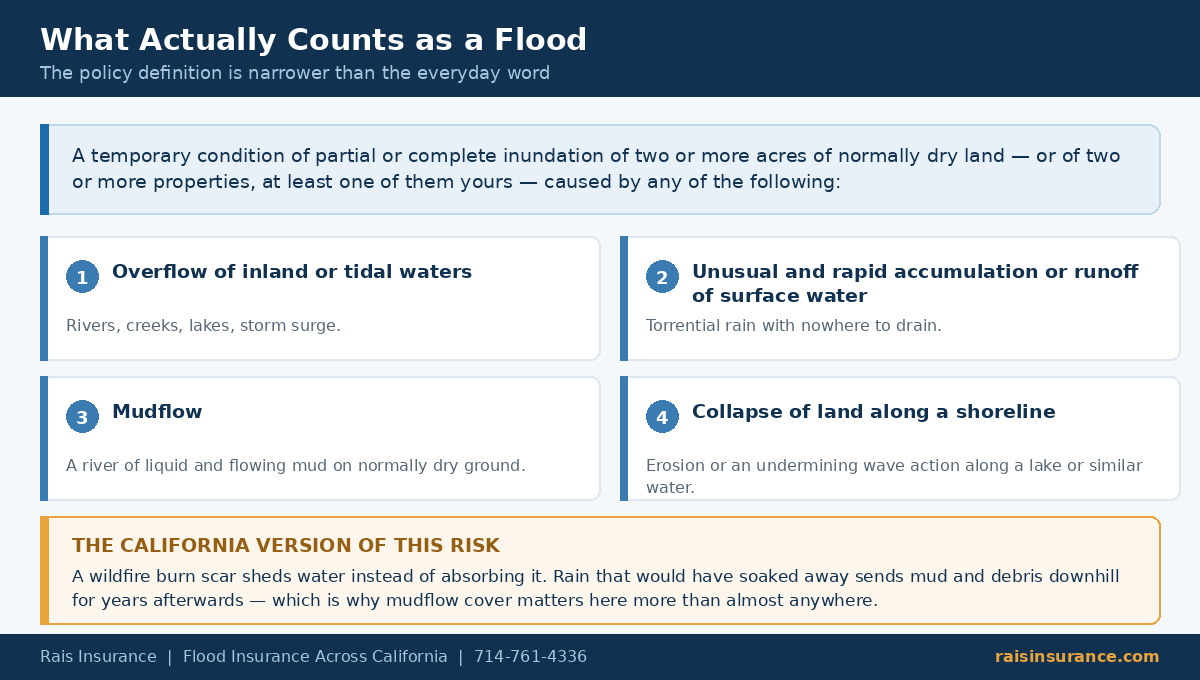
The policy definition is narrower than the everyday word, and it is worth reading properly. A flood is a temporary condition of partial or complete inundation of two or more acres of normally dry land — or of two or more properties, at least one of them yours — caused by:
- Overflow of inland or tidal waters — rivers, creeks, lakes, storm surge.
- Unusual and rapid accumulation or runoff of surface water from any source — torrential rain with nowhere to drain.
- Mudflow — a river of liquid and flowing mud carried across normally dry ground.
- Collapse or subsidence of land along a shoreline — erosion or undermining wave action along a lake or similar body of water.
Equally important is what is not a flood under this definition. A burst pipe, a sewer backup, or groundwater seeping through a foundation are different problems with different answers, and a flood policy will not respond to them.
Wildfire Burn Scars and Mudflow
This is the part of flood risk that is specific to California. A hillside that has burned sheds water instead of absorbing it, and rain that would once have soaked away runs off carrying mud, ash and debris. The elevated risk lasts for years after the fire is out, and it reaches properties that have never flooded before and are not in a mapped flood zone.
Mudflow is one of the causes named in the flood definition, so it is generally covered. Landslide and earth movement are not, and the distinction between them can matter a great deal in a claim. If you live below a burn scar, that is a conversation to have before the first winter storm, not after it. We see this pattern often in flood insurance Riverside quotes, since several communities there sit below burn-scarred hillsides.
NFIP or Private Flood Insurance?
There are two markets, and most Californians are only ever shown one.
The National Flood Insurance Program is the federal option, available in any participating community, with fixed limits of $250,000 on a home’s structure and $100,000 on its contents. Non-residential property can go to $500,000 on each.
The private flood market underwrites property by property. It frequently offers higher limits, shorter waiting periods, and temporary living expenses that the NFIP does not include — and on a good risk it is often cheaper as well. A compliant private policy satisfies a federally regulated lender.
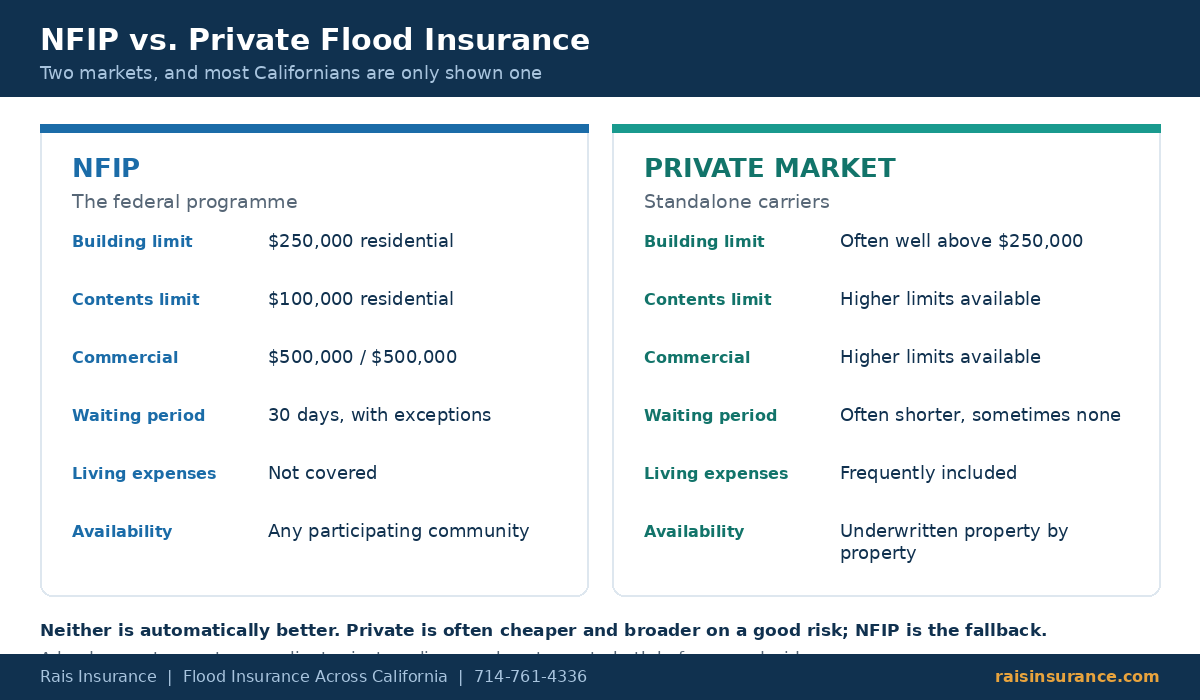
Neither is automatically the right answer. That is precisely why we quote both before recommending either. This comparison is exactly what a flood insurance quote California homeowners request should include — both markets, not just one.
When Does Flood Insurance Take Effect?
An NFIP policy generally takes effect 30 days after you pay the premium. That rule is real, and it is why flood cover cannot be bought once a storm is forecast — but it is not absolute, and the exceptions matter:
- Buying with a loan. There is normally no waiting period where cover is required in connection with making, increasing, extending or renewing a loan. If you are closing on a house, this is the exception that applies to you.
- Newly mapped into a flood zone. A one-day waiting period applies where a map revision has placed your property into a special flood hazard area and you buy within the qualifying window.
- After a wildfire. Where flooding results from post-wildfire conditions on federal land, the waiting period can be removed if the policy is bought in time.
- Private policies. Waiting periods are set by the carrier rather than by statute, and are often much shorter.
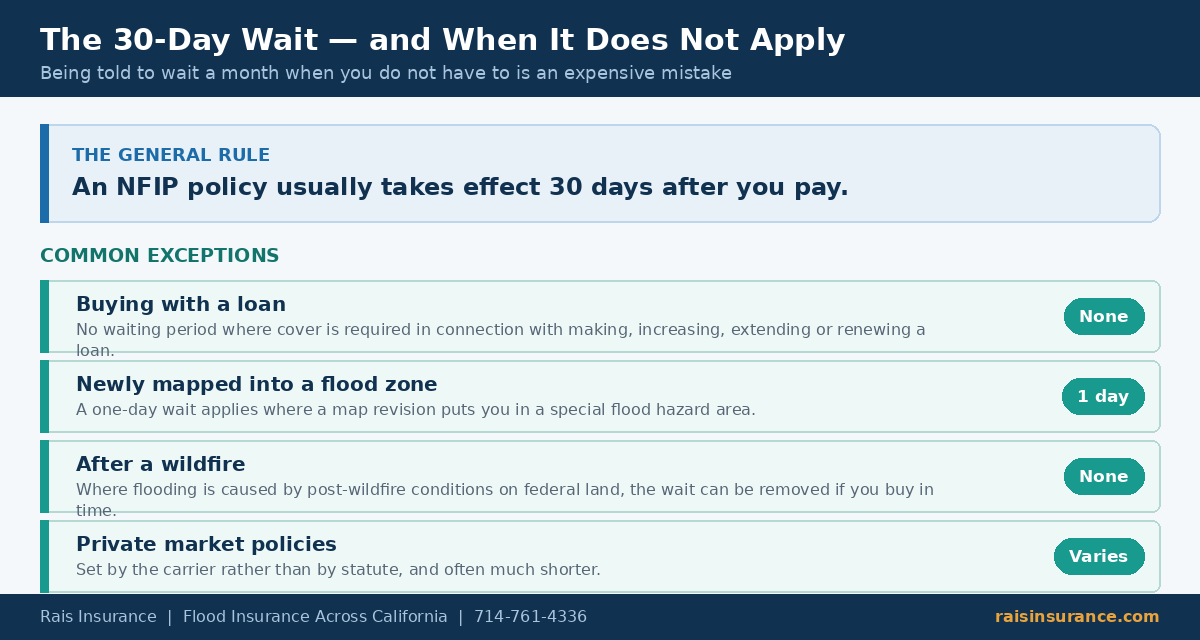
If someone has told you flood cover is thirty days away and you are mid-transaction, call us before you accept that. It is frequently not true.
Building and Contents Are Two Separate Coverages
This surprises people at claim time more than anything else on this page. Flood insurance is bought in two parts, and having one does not give you the other.
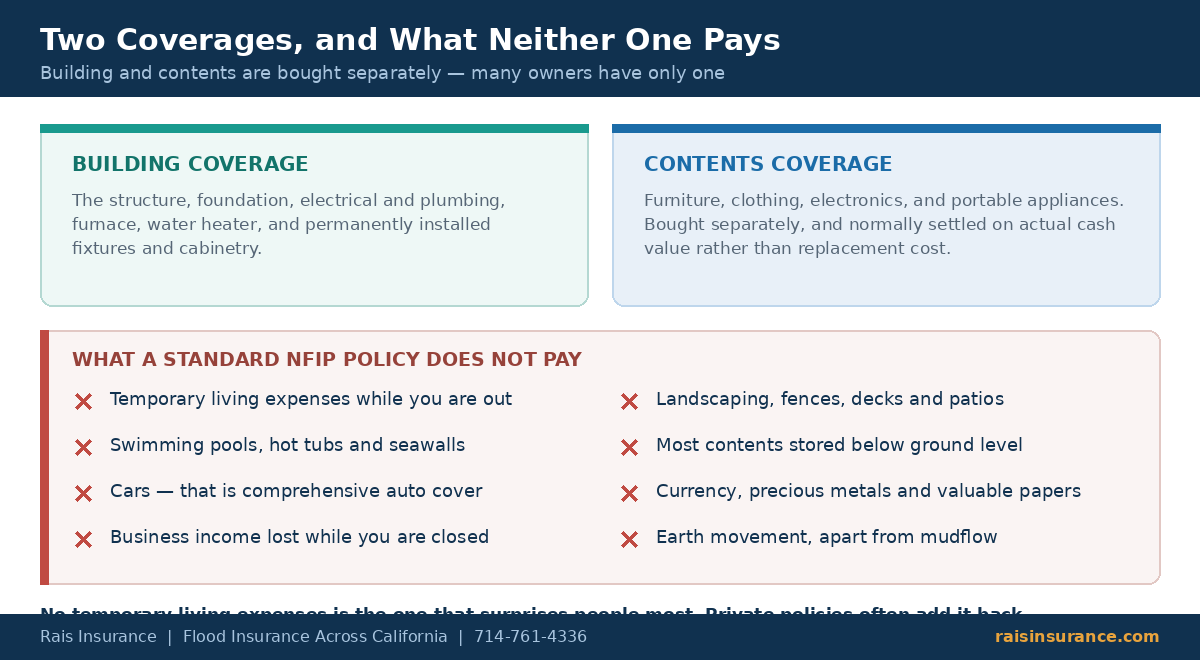
- Building coverage — the structure, foundation, electrical and plumbing systems, furnace, water heater, and permanently installed fixtures and cabinetry.
- Contents coverage — furniture, clothing, electronics and portable appliances. Under the NFIP this is normally settled on actual cash value rather than replacement cost.
If your home would cost more than $250,000 to rebuild, excess flood insurance sits above the NFIP limit and covers the difference. On much of the California coast, that is not an unusual requirement — it is the normal one.
What Flood Insurance Does Not Cover
A standard NFIP policy will not pay for:
- Temporary living expenses while your home is uninhabitable. This is the exclusion that shocks people, and many private policies add it back.
- Landscaping, fences, decks, patios, pools, hot tubs and seawalls
- Most personal belongings stored below ground level
- Vehicles — flood damage to a car is handled by comprehensive auto cover
- Currency, precious metals and valuable papers
- Business income lost while you are closed
- Earth movement, apart from mudflow
How Much Does Flood Insurance Cost?
The cost varies with your location, the flood risk rating for the property, the coverages included, and the value of what you are insuring. Before you start comparing plans, the FEMA flood map for your address will show you which zone you are in and how much attention this deserves.
Flood insurance California pricing has also changed. Under FEMA’s Risk Rating 2.0 methodology, NFIP premiums reflect the individual characteristics of your property — distance to a water source, the flood types it is exposed to, elevation, foundation type and rebuild cost — rather than the flood zone alone. Two neighbours in the same zone can now be priced very differently, which makes a personalised quote worth more than a rule of thumb. California flood insurance cost varies so much by property that two neighbours on the same street can see very different numbers under Risk Rating 2.0.
Is Flood Insurance Mandatory in California?
Home insurance for flood areas is mandatory in some cases, where it is required by a lender because your home is under a mortgage. Where the property sits in a designated high-risk flood area and the lender is federally regulated, flood insurance will be a condition of the loan. They still have money in the property, and they want it protected.
Elsewhere it is a choice, and your community’s participation affects what is available. The NFIP Community Status Book will tell you whether your community takes part in the programme. It is worth knowing that a substantial share of flood claims come from properties outside high-risk zones — where cover is also considerably cheaper. We place flood insurance Sacramento homeowners need near the river deltas, where lender requirements are common.
Why Work With Rais Insurance
Rais Insurance is an independent flood insurance agency serving California, and flood matters here — a great many regions across the state are exposed to it in one form or another. That includes flood insurance San Jose homeowners in the South Bay ask about, alongside coastal and valley properties statewide.
What we actually do is quote both markets side by side, read the inclusions and exclusions with you before you commit, and tell you plainly where a policy stops. Before choosing any flood policy you should ask exactly those questions, of us or of anyone else.
We write flood insurance California-wide — coastal properties, valley homes, and commercial buildings — and home insurance for flood areas is one of the most common conversations we have. Flood insurance Anaheim residents call us about most often, since that’s the community we work from every day.
Because we also write home insurance and commercial property insurance, flood cover can sit alongside the rest of your programme on one renewal calendar rather than being handled somewhere else entirely.
Get a Flood Insurance Quote in California
To quote it we need the property address, the year it was built, the foundation type, the rebuild cost you are insuring to, and your lender’s requirement if there is one. With those, we can price the NFIP and the private market against each other.
Get the best available quote and terms on a flood insurance policy from Rais Insurance. Call 714-761-4336 or email rai@raisinsurance.com — and if you are mid-transaction, mention it, because it changes when cover can start. Whether you need a flood insurance quote California-wide or want your California flood insurance cost compared against the private market, send us the property details and we’ll price both — from flood insurance San Jose requests to flood insurance Anaheim renewals, we quote every property the same way.
California Flood Insurance FAQs
Q1. Does homeowners insurance cover flood damage?
No. Standard homeowners and commercial property policies exclude flood, which is why it has to be bought as a separate policy. This is the single most common and most expensive misunderstanding in California property insurance, and people usually discover it after the water has gone down.
Q2. How much does flood insurance cost in California?
It depends on your specific property rather than your zone alone. Since FEMA moved to Risk Rating 2.0, NFIP pricing reflects distance to water, flood types, elevation, foundation type and rebuild cost. Private carriers underwrite individually too. The only reliable answer comes from quoting your actual address in both markets. This is especially true along the coast, where a flood insurance Los Angeles quote and a flood insurance San Francisco quote for a similar-value home can differ significantly based on elevation and distance to water.
Q3. Is flood insurance required in California?
Not by state law, but a federally regulated or insured lender must require it for a property in a high-risk flood area. Outside those zones it is voluntary, which is worth knowing given that a large share of flood claims come from properties nobody classed as high risk. Lenders arranging flood insurance Riverside and flood insurance Sacramento closings often require proof of this coverage before funding, which is worth confirming early in escrow.
Q4. How long before flood insurance takes effect?
An NFIP policy generally takes effect 30 days after purchase, but there are important exceptions. There is normally no wait where cover is required in connection with a loan, a one-day wait after certain map revisions, and relief following some post-wildfire flooding. Private policies set their own, often shorter, waiting periods.
Q5. What is the difference between NFIP and private flood insurance?
The NFIP is the federal programme, with fixed limits of $250,000 building and $100,000 contents for a home. Private carriers underwrite property by property and frequently offer higher limits, shorter waiting periods, and temporary living expenses that the NFIP does not include. A compliant private policy satisfies a lender.
Q6. How much will an NFIP policy pay out?
Up to $250,000 on the building and $100,000 on contents for a residential property, and up to $500,000 on each for a non-residential one. Building and contents are separate purchases. If your home is worth more than the building limit, excess flood cover sits above it.
Q7. Does flood insurance cover temporary living expenses?
A standard NFIP policy does not. If your home is uninhabitable after a flood, the cost of staying somewhere else is yours. Many private flood policies do include it, which is one of the strongest practical reasons to see quotes from both markets before deciding.
Q8. Does flood insurance cover mudflow after a wildfire?
Mudflow is one of the causes named in the flood definition, so it is generally covered. Landslide and earth movement are not, and the line between them can matter in a claim. Given how much of California sits below a burn scar, this is worth discussing for your specific property rather than assuming.
Q9. Do I need flood insurance if I am not in a flood zone?
Everywhere is in a flood zone — the question is which one. Properties outside designated high-risk areas still flood, and a substantial share of claims come from them. Cover outside a high-risk zone is usually much cheaper, which makes it one of the better value decisions in property insurance. A denied or underpaid flood claim California homeowners file after assuming they were ‘not in a flood zone’ is one of the most common and preventable regrets we see.
Q10. Does flood insurance cover my basement?
Only partially. Cover below the lowest floor is limited, and most personal belongings stored there are excluded. Building items such as the furnace, water heater and electrical panel are generally covered. If you use a basement as living space, check exactly what applies before you need it.
