

Auto Insurance Long Beach California
Auto insurance for Long Beach drivers, quoted across several carriers by Rais Insurance.Long Beach driving has its own hazards – the marine layer rolling in, heavy port and freight traffic, and the first rain after a dry spell, which is genuinely the worst road surface of the year. Auto insurance Long Beach drivers carry has to answer all of that, and a few things people expect it to answer and it does not. Getting long beach car insurance right means matching the policy to these local risks, not just meeting the state minimum.
That second part is where this car insurance guide starts, because several benefits commonly promised are not standard at all. Two of them are real – and you have to ask for them by name. This page covers what car insurance long beach ca actually includes, not just what it’s marketed as.
Four Things Worth Checking Before You Rely on Them
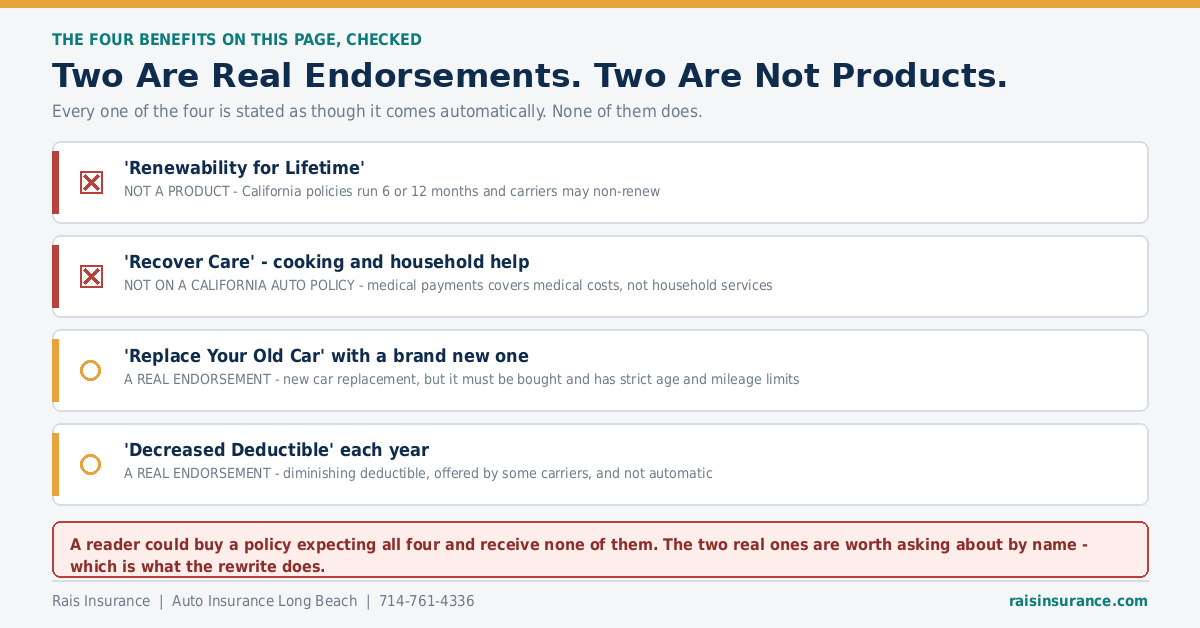
These are the four car insurance benefits the original version of this page lists. Every one is stated as though it arrives automatically with any policy. None of them does:
- “Renewability for lifetime” – not a product. California policies run in six or twelve month terms, and each renewal is a fresh decision by the carrier.
- Household and living expenses if you are injured – not a benefit of a California personal auto policy. Medical payments cover pays medical costs; cooking, transportation and household help are not part of it.
- Replacement with a brand new car of the same make and model – a real endorsement called new car replacement, and it must be bought. A standard policy pays the vehicle’s depreciated value.
- A deductible that falls every year – also a real endorsement, usually called a diminishing or disappearing deductible. Offered by some carriers, and never automatic.
The two real ones are worth pursuing, because they are inexpensive on the right vehicle and almost nobody thinks to ask. Chasing the cheapest car insurance long beach quote without checking these endorsements can mean paying for gaps you didn’t know you had.
New car replacement – the one worth asking about
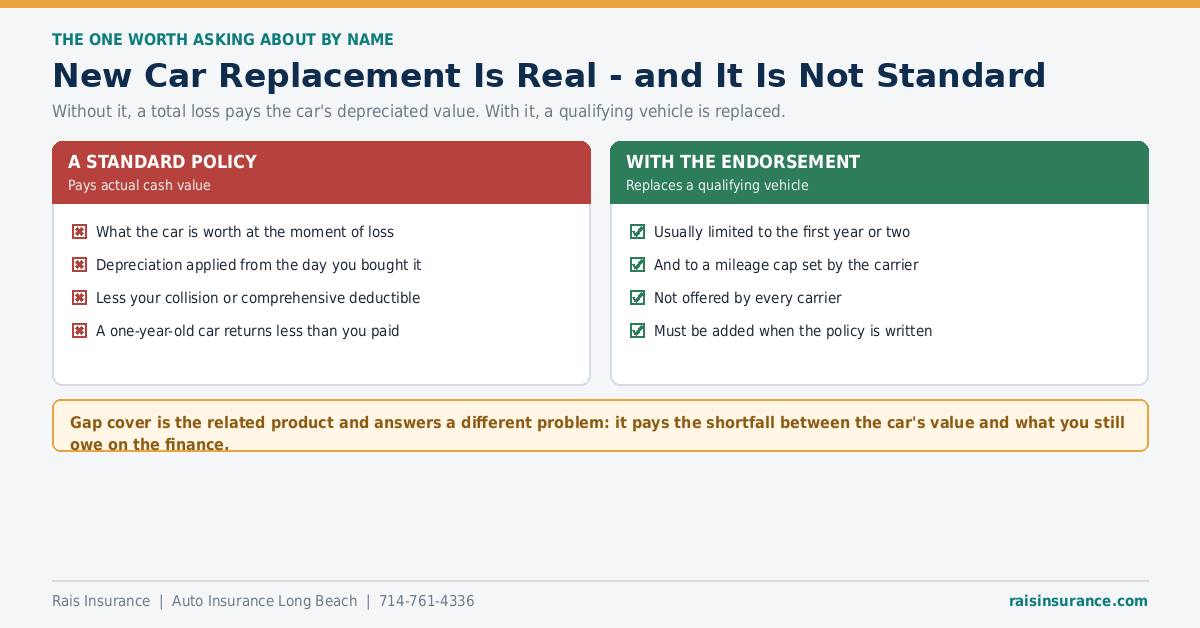
Under a standard policy, a total loss is settled at actual cash value – what the car was worth at the moment of the loss, with depreciation applied, less your deductible. A one-year-old vehicle returns meaningfully less than you paid for it.
New car replacement changes that for a qualifying vehicle. The conditions matter: it is usually limited to the first year or two of ownership and to a mileage cap, it is not offered by every carrier, and it has to be added when the policy is written rather than after a loss.
Gap cover is the related product and answers a different problem – it pays the shortfall between the vehicle’s value and what you still owe on the finance. A financed new car can benefit from both. See when collision and comprehensive stop earning their premium for how actual cash value works as a car ages. Adding the right endorsement is often what keeps affordable auto insurance long beach ca 90804 policies from turning into a bad surprise at claim time.
Renewal, and what a clean record really buys
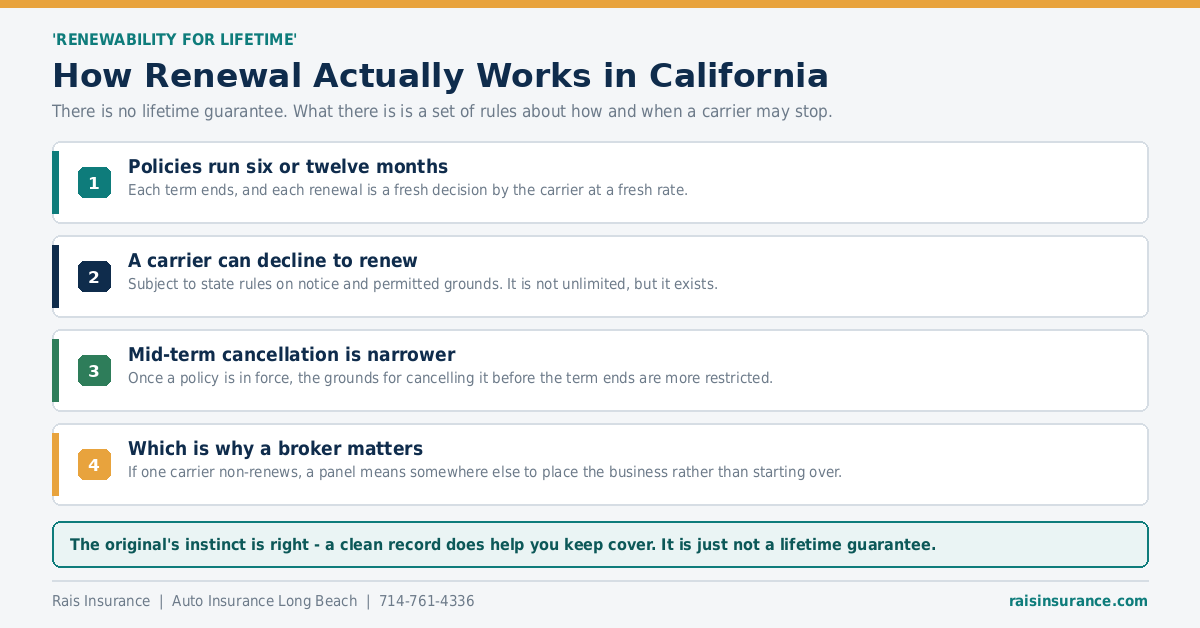
The original’s instinct here is sound – a clean record does help you keep cover – but there is no lifetime guarantee, and it is worth knowing how this actually works:
- Policies run six or twelve months, and each renewal is a fresh decision at a fresh rate.
- A carrier can decline to renew, subject to California’s rules on notice and permitted grounds.
- Mid-term cancellation is narrower. Once a policy is in force, the grounds for ending it before the term expires are more restricted than the grounds for declining a renewal.
- Which is one of the better arguments for a broker. If one carrier non-renews, a panel means somewhere else to place the business rather than starting from scratch. It’s also why car insurance agents long beach drivers trust tend to work a panel of carriers rather than just one.
The Weather That Actually Matters Here
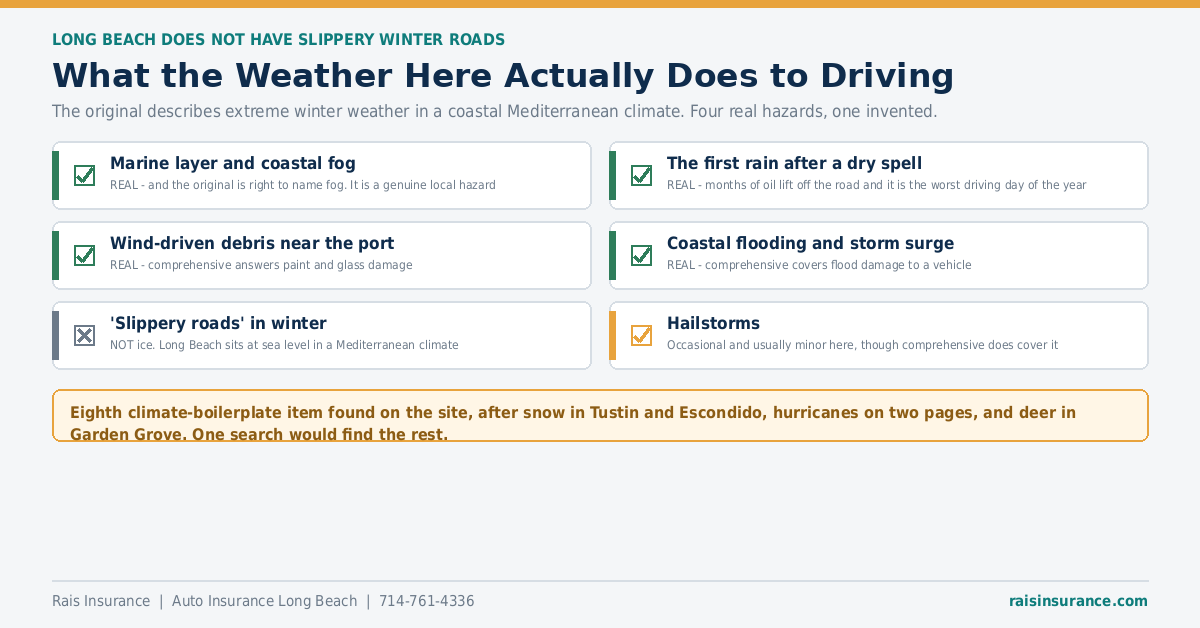
The original describes dangerous winter driving on slippery roads. Long Beach sits at sea level in a coastal Mediterranean climate, so icy roads are not the hazard – but it is right about fog, and there are three others worth naming:
- Marine layer and coastal fog. A genuine visibility hazard, and the original names it correctly.
- The first rain after a dry spell. Months of accumulated oil and rubber lift off the road surface, and it is the worst driving day of the year here by a distance.
- Wind-driven debris near the port, which damages paint and glass. Comprehensive answers it.
- Coastal flooding and storm surge. Comprehensive covers flood damage to a vehicle – unlike a homeowners policy, which excludes flood entirely.
On the other hazards the page names: a car ending up in a ditch is a collision claim, single-vehicle and paid regardless of fault. Fire and hail both fall under comprehensive, along with the animal strikes mentioned later – see what comprehensive coverage actually covers. Coastal ZIP codes like auto insurance long beach ca 90804 territory see these hazards more than inland Long Beach addresses do.
What We Can Actually Offer
The original is right on two counts here. Comprehensive coverage does answer theft and animal strikes – both correct, and the animal strike point in particular surprises most drivers, because it feels like a collision and is not.
And discounts are real, though the page names none. The ones worth asking about:
- California’s good driver discount, which is statutory – carriers must offer it to qualifying drivers.
- Bundling with home or renters cover, usually the single largest reduction available.
- Multi-vehicle, where a household insures more than one car on the same policy.
- Accurate annual mileage, which is not a discount as such but one of the three factors California law requires to weigh most heavily. An out-of-date commute figure costs money every year.
None of these is applied automatically. See what determines your premium in California. Asking about every one of these is simply part of shopping long beach car insurance properly.
One coverage belongs on any California list and is absent from the original: uninsured motorist and underinsured motorist cover. It is optional here, a carrier must obtain your decline in writing, and it responds when the at-fault driver has no insurance or not enough of it. None of this is about finding the single cheap car insurance long beach quote — it’s about making sure that quote still covers what matters.
Driving in Long Beach
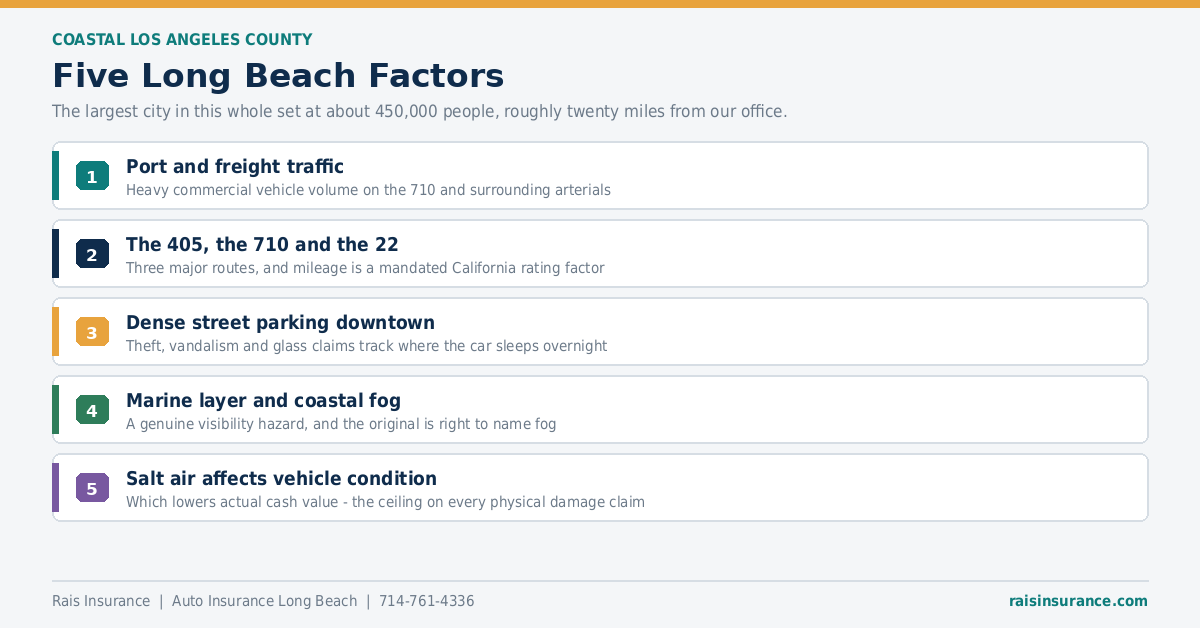
Five things that shape car insurance Long Beach rates specifically, on top of the auto insurance Long Beach basics above:
- Port and freight traffic. Heavy commercial vehicle volume on the 710 and the arterials feeding it.
- The 405, the 710 and the 22, and annual mileage is one of the three mandated rating factors.
- Dense street parking downtown, which drives theft, vandalism and glass claims – all comprehensive.
- Marine layer and coastal fog, a real visibility hazard through the spring and early summer.
- Salt air affects vehicle condition, and condition sets actual cash value – which caps every physical damage claim.
Not all car insurance companies in Long Beach, CA price these five factors the same way, which is exactly why comparing across a panel matters. These are also the local factors that make car insurance long beach ca pricing different from a generic statewide quote.
Getting the Right Policy Together
Car insurance is a legal requirement in California, and the useful work is not simply having it – it is knowing which parts you hold, which you have declined, and which optional endorsements are worth adding for your particular vehicle. Car insurance agents long beach residents call directly, rather than a national call centre, generally catch these gaps before they become a claim problem.
As an independent broker we place business across a panel of carriers rather than selling one company’s products, so one set of details gets quoted several times – see the insurance companies we represent. We are not an insurance company; the carrier issues the policy and pays the claim, and there is no fee to you for the comparison. The current minimum requirements are on our auto insurance in California page. Ask us at the same time about home and auto insurance in Long Beach — bundling is usually the single largest discount available on both policies.
Auto Insurance in Long Beach – Frequently Asked Questions
Q1. Will my insurance replace my car with a brand new one?
Not under a standard policy. A total loss is settled at the vehicle’s actual cash value – what it was worth at the moment of the loss, with depreciation applied – less your deductible. NEW CAR REPLACEMENT is a real optional endorsement that does replace a qualifying vehicle, but it has to be added to the policy, it is usually limited to the first year or two and to a mileage cap, and not every carrier offers it. That’s the kind of detail we walk through when quoting affordable auto insurance long beach ca 90804 for a newer vehicle.
Q2. What is the difference between new car replacement and gap insurance?
They answer different problems. New car replacement addresses what the car is worth: it replaces a qualifying vehicle rather than paying its depreciated value. Gap cover addresses what you owe: it pays the shortfall between the vehicle’s value and the outstanding finance balance. A financed new car can benefit from both.
Q3. Does my deductible go down each year?
Not automatically. Some carriers offer a DIMINISHING or disappearing deductible endorsement, which reduces your deductible for each claim-free year up to a limit – but it is an optional add-on that must be bought, not a feature of every policy. It is worth asking about by name if a clean record is something you expect to keep.
Q4. Can my insurance company refuse to renew my policy?
Yes, subject to California’s rules on notice and permitted grounds. There is no lifetime renewal guarantee – policies run in six or twelve month terms and each renewal is a fresh decision at a fresh rate. Mid-term cancellation is more restricted than non-renewal. A clean record certainly helps, and it is one of the better reasons to use a broker: if one carrier declines to renew, a panel means somewhere else to place the business. It’s one more reason to work with car insurance companies in Long Beach, CA through a broker rather than a single captive agent.
Q5. Does auto insurance cover household expenses if I am injured?
Not on a California personal auto policy. MEDICAL PAYMENTS coverage pays medical costs for you and your passengers without establishing fault, and the at-fault driver’s liability may respond to a broader injury claim including lost earnings – but cooking, transportation and household help are not benefits a standard auto policy provides here.
Q6. Does comprehensive cover hitting an animal?
Yes, and the original version of this page is right about it. Animal strikes fall under comprehensive rather than collision, which surprises most drivers because it feels like a collision. Comprehensive also answers theft, fire, vandalism, weather, flood and falling objects.
Q7. What happens if my car ends up in a ditch?
That is a collision claim – a single-vehicle collision, paid regardless of fault, subject to your collision deductible. Collision is optional coverage, so a liability-only policy will not respond to it at all.
Q8. Is driving in Long Beach dangerous in winter?
Not for the reasons that apply inland or in colder states. Long Beach sits at sea level in a coastal Mediterranean climate, so icy roads are not the issue. What does matter is the marine layer and coastal fog, the first rain after a dry spell when months of oil lift off the road surface, wind-driven debris near the port, and occasional coastal flooding.
Q9. What discounts might I qualify for?
California’s good driver discount is statutory and carriers must offer it to qualifying drivers. Beyond that: bundling with home or renters cover is usually the largest single reduction, and multi-vehicle, good student, and accurate low-mileage reporting all help. None of these is applied automatically – they have to be asked for and evidenced. Stacking these discounts is usually the real route to the cheapest car insurance long beach drivers can responsibly carry. Bundling home and auto insurance in Long Beach under one carrier is one discount worth asking about even if it isn’t listed by name.
Q10. How do I get a Long Beach auto insurance quote?
Call Rais Insurance on 714-761-4336 or email rai@raisinsurance.com. Our office is in Anaheim, about twenty miles away. We are an independent broker, so one set of details is quoted across several carriers, and there is no fee to you for the comparison. That’s the fastest way to get car insurance long beach ca pricing that actually reflects your address and driving history.
Get a Car Insurance Quote in Long Beach
contact Rais Insurance on 714-761-4336 or email rai@raisinsurance.com. We take payment by several methods, and can talk through which car insurance endorsements are worth the premium on your particular car. We’re happy to walk through your long beach car insurance options over the phone before you commit to anything, and if cheap car insurance long beach is the goal, we’ll tell you honestly where a lower price means a real coverage tradeoff.
If your vehicle is less than a year or two old, ask about new car replacement specifically. It is the one item on this page most likely to be worth money to you, and it cannot be added after a loss. If you’re specifically searching auto insurance long beach ca 90804, mention your ZIP when you call so the quote reflects the right garaging territory.
