

Is Health Insurance Required in California?
This guide covers what the California health insurance mandate actually requires, what counts as coverage, who is exempt, and what to do if you are uninsured right now. One note before the detail: the dollar figures and income thresholds behind all of this are adjusted every year, so this page deliberately explains how the rules work rather than quoting amounts that would be out of date within months. Current figures are linked at the end.
The Federal Penalty Ended. California’s Did Not.
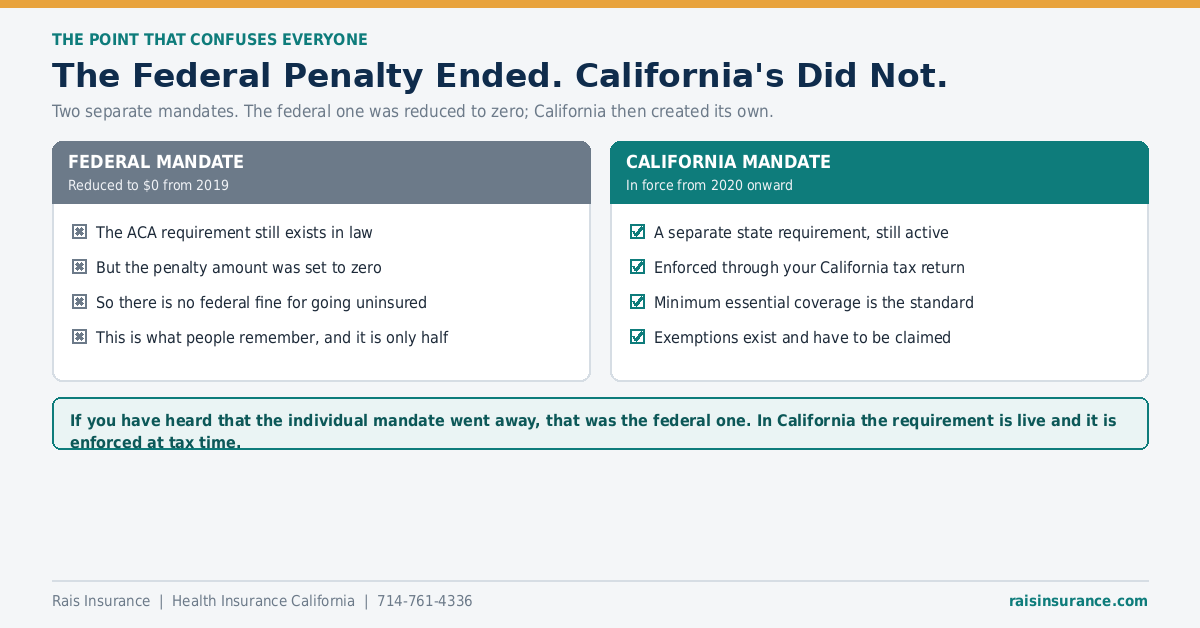
This is the single biggest source of confusion, and it is worth separating cleanly.
The federal mandate created by the Affordable Care Act still exists in law, but its penalty was reduced to zero from 2019. There is no federal fine for going uninsured. That is what most people remember, and it is only half the story.
The California health insurance mandate is a separate state requirement that took effect in 2020 and remains active. California residents are expected to maintain minimum essential coverage for themselves and their dependents, and the California health insurance penalty is assessed on your state return rather than your federal one.
The penalty itself is calculated as either a flat amount per adult and per dependent child, or a percentage of household income above the filing threshold – whichever is greater. Both the flat amount and the thresholds move each year, so check the current figures with the California Franchise Tax Board rather than relying on any article.
What Actually Counts as Coverage
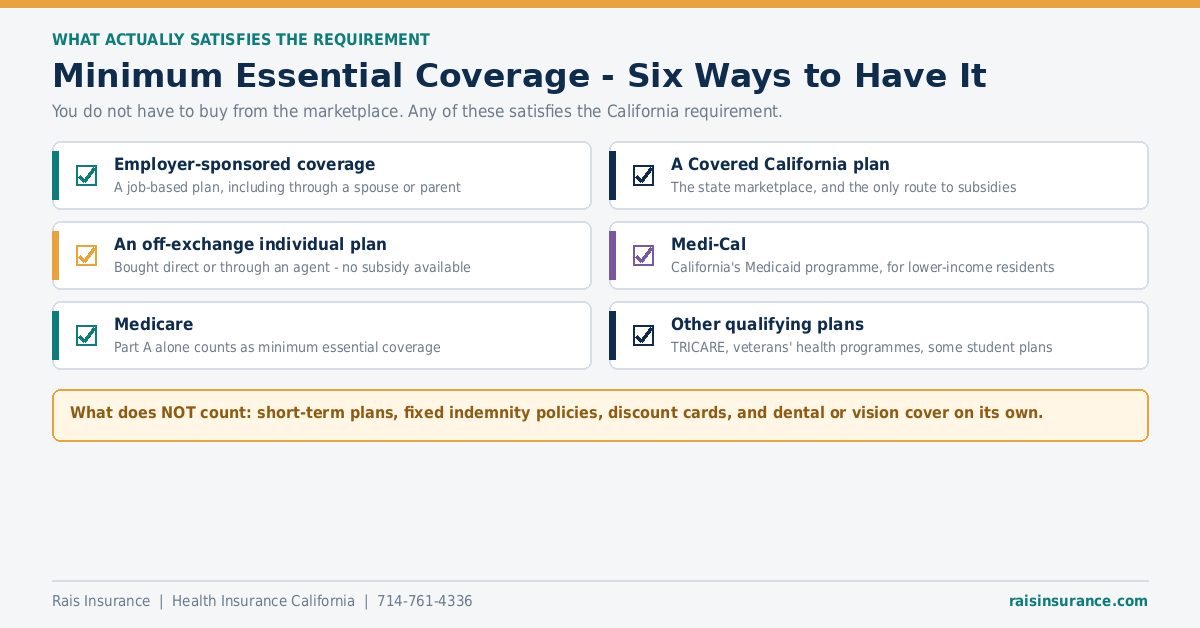
You do not have to buy from the marketplace to satisfy the requirement. Any of the following counts as minimum essential coverage:
- Employer-sponsored coverage – a job-based plan, including one you are on through a spouse or parent.
- A Covered California plan – the state marketplace, and the only route to financial help. See Covered California and how the exchange works.
- An off-exchange individual plan – bought direct from a carrier or through an agent. It satisfies the mandate, but no subsidy is available on it.
- Medi-Cal – California’s Medicaid programme, for eligible lower-income residents. Enrollment is open all year.
- Medicare – Part A on its own counts as minimum essential coverage.
- Other qualifying programmes – TRICARE, veterans’ health cover, and certain student health plans.
What does not count: short-term plans, fixed indemnity policies, healthcare sharing arrangements, discount cards, and standalone dental or vision cover. Holding one of those and believing you are covered is a common and expensive mistake. On how the plan types differ once you are choosing, see common health insurance questions answered.
Short-Term Plans – a Correction
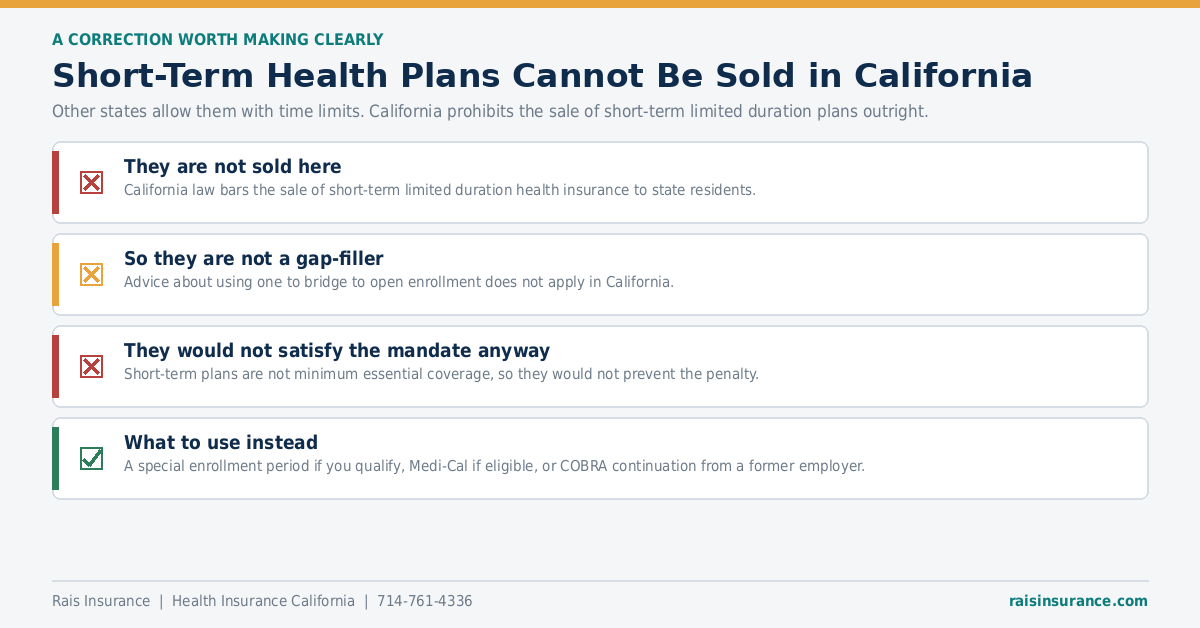
Short-term health plans are often suggested as a way to bridge a gap until the next open enrollment. That advice circulates widely, and it does not apply in California.
California prohibits the sale of short-term limited duration health insurance to state residents. Other states permit them, sometimes with a duration cap – California does not permit them at all. So the question of how many months one can run does not arise here.
It would not help even if it did. Short-term plans are not minimum essential coverage, so holding one would not prevent the penalty. If you need to bridge a gap, the real options are a special enrollment period if you qualify, Medi-Cal if you are eligible, or COBRA continuation from a former employer.
Who Does Not Have to Pay
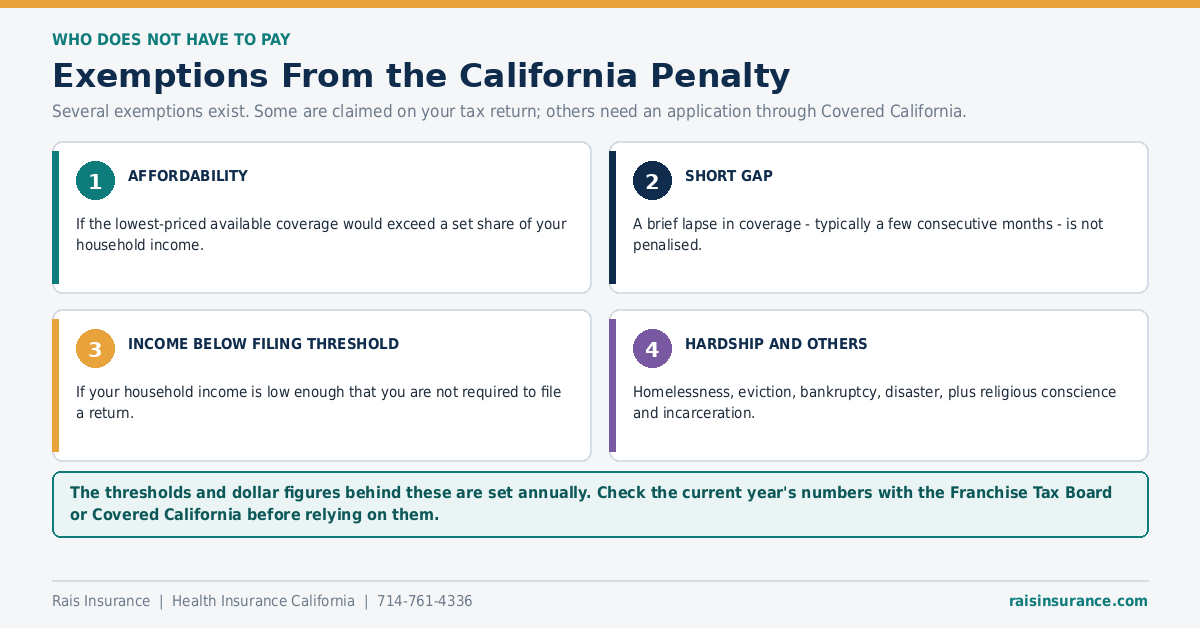
Several exemptions exist, and a good number of people who assume they owe the California health insurance penalty do not. The main categories:
- Affordability – where the lowest-priced coverage available to you would cost more than a set share of household income. In practice this is the largest category.
- A short gap in coverage – a brief consecutive lapse is not penalised, which matters for anyone changing jobs.
- Income below the filing threshold – if your household income is low enough that you are not required to file a return.
- Hardship – homelessness, eviction, bankruptcy, disaster and similar circumstances.
- Religious conscience and incarceration are also recognised.
Some exemptions are claimed directly on your tax return; others require an application through Covered California, and the two routes have different deadlines. The income thresholds and percentages behind each are set annually, so confirm the current year’s figures before relying on them.
Financial Help, and the One Rule That Matters
California offers financial assistance to bring premiums down, layered on top of federal help, and the structure of that assistance has been revised more than once since it was introduced. The current eligibility bands, percentages and dollar amounts are published by Covered California each year.
The rule that does not change is this: financial help is only available through Covered California. If you would qualify for a subsidy and you buy an off-exchange plan instead, you forfeit it entirely – not reduced, not claimed back later, forfeited. It is the single most expensive mistake people make in this market, and it is completely avoidable.
Two related points worth knowing. Eligibility is based on your estimated income for the coverage year, and it is reconciled when you file, so a mid-year change in earnings is worth reporting rather than leaving. And if you are already enrolled, your plan will generally auto-renew – which is convenient, but it also means you may miss a better-priced plan if you never look.
If You Are Uninsured Right Now
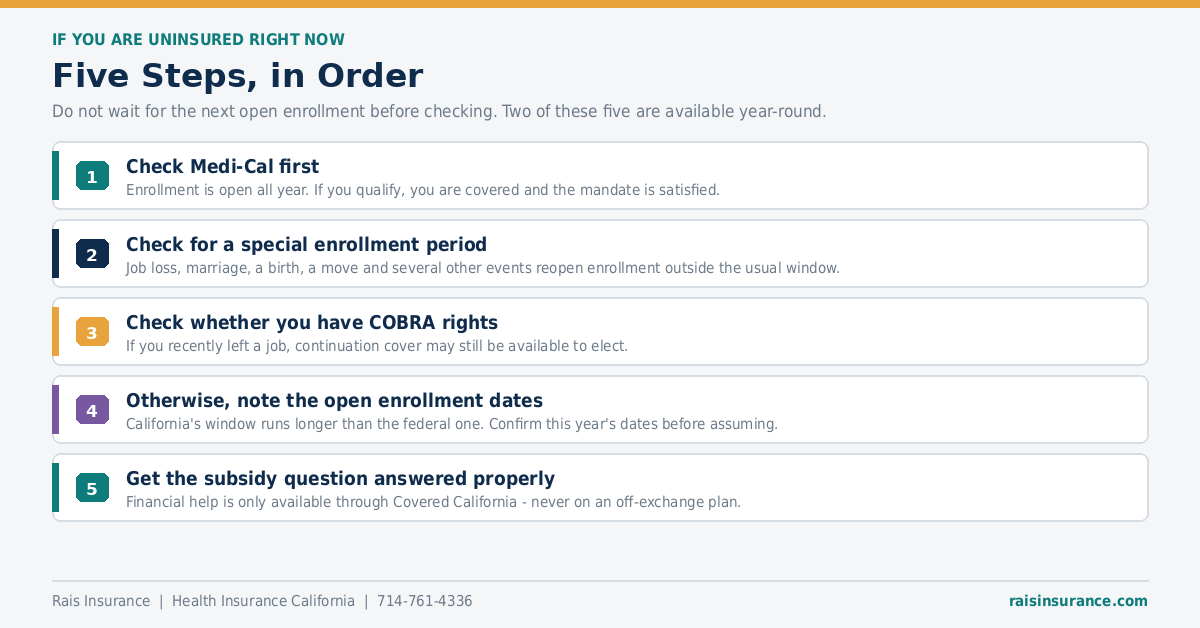
The common assumption is that nothing can be done until the next open enrollment. That is often wrong – two of these five routes are open all year:
- Check Medi-Cal first. Enrollment runs year-round and eligibility is broader than many people expect. If you qualify, you are covered and the requirement is satisfied.
- Check for a special enrollment period. Losing job-based coverage, marriage, a birth, a move and several other qualifying life events reopen enrollment outside the usual window.
- Check your COBRA rights. If you recently left a job, continuation cover may still be available – usually the most expensive of the three, but it keeps your existing plan and doctors.
- Otherwise, note the open enrollment dates. California’s window runs longer than the federal one, and the exact dates are set each year. Confirm them rather than assuming.
- Get the subsidy question answered before you buy. It determines where you should be buying, not just what you pay.
The Argument Beyond the Penalty
It is worth saying that the penalty is the least important reason to be insured. A single unplanned hospital admission can cost more than several years of premiums, and the price of care in California is not something anyone negotiates well from an emergency room.
The mandate exists because coverage works best when the pool includes people who do not currently need it. But the practical case is simpler: being uninsured transfers a very large, very unpredictable risk onto your own balance sheet, and unlike most risks it is one you cannot choose the timing of.
Where to Check Current Figures
Because every dollar amount on this subject changes annually, the two authoritative sources are worth bookmarking rather than trusting a figure in an article:
- Covered California – for plan options, current subsidy eligibility, open enrollment dates and exemption applications.
- The California Franchise Tax Board – for the current penalty calculation and the exemptions claimed on your return.
If you would rather have someone walk you through what applies to your household, that is what we do. Our health insurance California page sets out how we can help.
California Health Insurance Requirement – Frequently Asked Questions
Q1. Is health insurance still required in California?
Yes. The federal individual mandate penalty was reduced to zero from 2019, but California introduced its own state requirement that took effect in 2020 and remains in force. California residents are expected to maintain minimum essential coverage for themselves and their dependents, and the requirement is enforced through the state tax return rather than the federal one.
Q2. How much is the California health insurance penalty?
The penalty is calculated as either a flat amount per adult and per dependent child, or a percentage of household income above the filing threshold – whichever is greater. Both the flat amount and the thresholds are adjusted annually, so the current year’s figures should be checked with the California Franchise Tax Board rather than taken from any article, including this one.
Q3. What counts as minimum essential coverage?
Employer-sponsored coverage, a Covered California marketplace plan, an off-exchange individual plan, Medi-Cal, Medicare Part A, and certain other programmes including TRICARE and veterans’ health cover. What does not count: short-term plans, fixed indemnity policies, healthcare sharing arrangements, discount cards, and standalone dental or vision cover.
Q4. Are short-term health plans allowed in California?
No. California prohibits the sale of short-term limited duration health insurance to state residents, which makes it different from most states. Even where they are available elsewhere, short-term plans are not minimum essential coverage, so they would not prevent a penalty. If you need to bridge a gap, look at a special enrollment period, Medi-Cal, or COBRA continuation instead.
Q5. Who is exempt from the California penalty?
The main categories are affordability – where the lowest-priced available coverage would exceed a set share of household income – a short gap in coverage, income below the tax filing threshold, and various hardship grounds including homelessness, eviction, bankruptcy and disaster. Religious conscience and incarceration are also recognised. Some exemptions are claimed on your return; others require an application through Covered California.
Q6. What is the short gap exemption?
A brief lapse in coverage is not penalised. If you were uninsured for only a short consecutive period during the year, that gap generally does not attract a penalty – which matters for anyone changing jobs. The exact number of months and how multiple gaps are treated should be confirmed against current Franchise Tax Board guidance.
Q7. Do I have to buy through Covered California?
No – any minimum essential coverage satisfies the requirement, including a plan bought directly from a carrier or through an agent. But financial help is only available through Covered California. If you would qualify for a subsidy and you buy off-exchange instead, you forfeit it entirely, which is the single most expensive mistake people make here.
Q8. I lost my job and I am uninsured. What are my options?
Check Medi-Cal first, because enrollment is open all year and eligibility is broader than many people expect. Losing job-based coverage is also a qualifying event that opens a special enrollment period on Covered California, so you do not have to wait for open enrollment. COBRA continuation from your former employer is a third route, though usually the most expensive of the three.
Q9. When is open enrollment in California?
Covered California runs a longer open enrollment window than the federal marketplace, typically beginning in the autumn and continuing into the new year. Because the exact dates are set each year, confirm them on the Covered California site before relying on them – and remember that a qualifying life event lets you enroll outside the window entirely.
Q10. Is Medi-Cal the same as Medicaid?
Yes. Medi-Cal is California’s name for the Medicaid programme. It provides free or low-cost coverage to eligible lower-income residents, it counts as minimum essential coverage, and enrollment is open throughout the year rather than being limited to a window. It is worth checking eligibility before assuming you need to buy a plan.
Speak to a Licensed Agent in California
contact Rais Insurance on 714-761-4336, email rai@raisinsurance.com, or visit 2612 W. Lincoln Avenue, Suite 103, Anaheim, CA 92801.
Two things worth having ready: an estimate of your household income for the year, and whether anyone in the household has access to employer coverage. Those two answers determine almost everything else.